
Best 1.5 Ton 5 Star AC in India 2026
A 1.5-ton 5-star inverter AC is the default size for a normal Indian living room - but 2026's BEE reset means some units still wearing a 5-star badge are really 4-stars now. We read what verified owners report after installation, weighted that over launch-day specs, and ranked six.
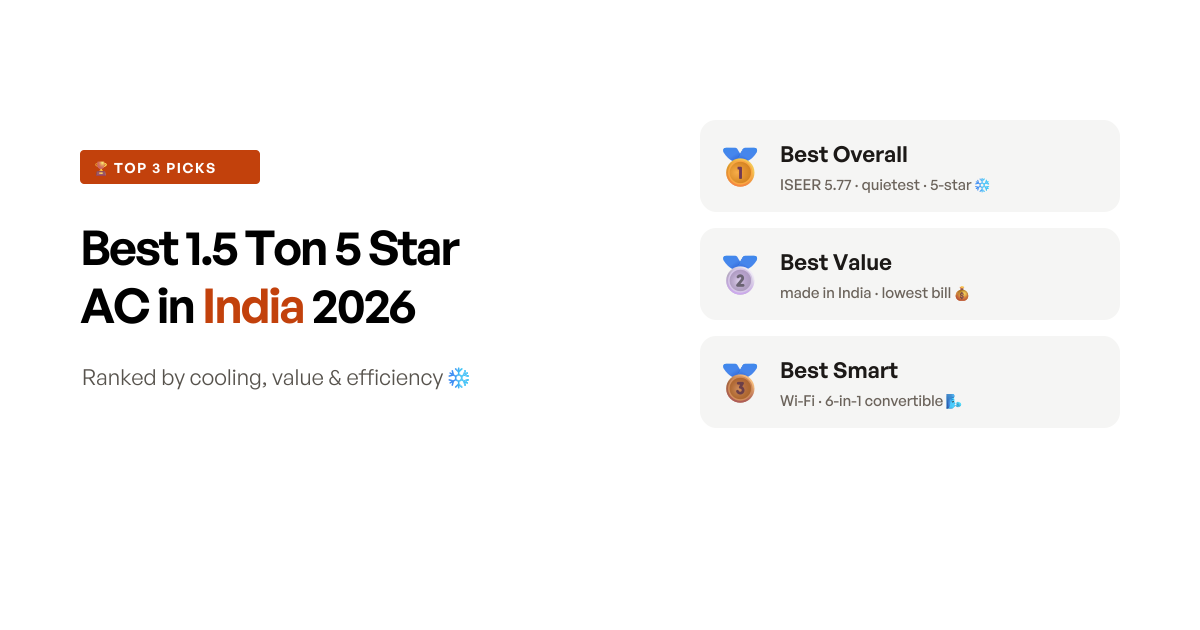
The quick answer
The LG AS-Q19YNZE1 wins on the combination that is hard to find in this field: it is the quietest indoor unit here at 31 dB, it is a genuine 2026 BEE 5-star at ISEER 5.77, and LG has the deepest service network behind the warranty - which is the thing that decides whether a 1.5-ton AC stays out of the repair queue in year two. It is the most expensive pick, its outdoor unit draws some noise complaints, and this particular variant has no Wi-Fi - but nothing in the owner reviews undercuts the core case, and the core case is quiet, efficient cooling you can actually get serviced.
If you want most of that for less money, the IFB CI195SS32SGM3 is the value pick and an extremely close second - it actually posts the lowest annual electricity rating on this list and the happiest owners, made in India for around 6,000 rupees less. The rest splits by need: the Carrier for smart and convertible features, the Panasonic for the highest ISEER on paper, the Hitachi for the strongest airflow, and the Lloyd for the lowest entry price.
Quick comparison
Six picks side by side - the use case each one wins, the price, and a Buy button for the impatient.
- 9.0 scoreBest overall
LG 1.5 Ton 5 Star AI Convertible Inverter Split AC (AS-Q19YNZE1)
The quietest, most efficient pick from the deepest service network here.
Read the reviewapprox. ₹48,490 - 8.9 scoreBest value
IFB 1.5 Ton 5 Star AI Inverter Split AC (CI195SS32SGM3)
The lowest running cost and the happiest owners - if your city has IFB service.
Read the reviewapprox. ₹42,490 - 8.5 scoreBest smart and convertible features
Carrier 1.5 Ton 5 Star Wi-Fi Flexicool Inverter Split AC (ESTER EDGE Gxi, CAI18EE5R36W0)
The feature-rich smart pick - excellent on a good install, frustrating on a bad one.
Read the reviewapprox. ₹46,989 - 8.3 scoreMost energy-efficient
Panasonic 1.5 Ton 5 Star Premium Wi-Fi Inverter Split AC (CS/CU-NU18BKY5WX)
The highest ISEER on paper - if you can survive the after-sales.
Read the reviewapprox. ₹47,989 - 8.2 scoreBest for fast cooling
Hitachi 1.5 Ton 5 Star Xpandable+ Inverter Split AC (5400STXL, RAS.G518PCCIBT)
The strongest airflow here - and a real gamble on after-sales.
Read the reviewapprox. ₹40,749 - 8.1 scoreBest budget pick
Lloyd 1.5 Ton 5 Star Inverter Split AC (GLS18I5KWGGW)
The cheapest way in - the marginal pick, if you open-box it.
Read the reviewapprox. ₹38,490
How we shortlisted
The thing that makes a 1.5-ton 5-star search confusing in 2026 is that “5 star” no longer means one thing. The BEE efficiency table was reset on 1 January 2026, and the bar for every star moved up - so a unit that earned five stars under the 2022 or 2025 table can be a four-star now without anything about the machine changing. Several listings say this in their own fine print. Of the units we looked at, the genuinely 2026-rated 5-stars are the efficient ones - the LG (ISEER 5.77), Panasonic (5.80), IFB (5.65) and Carrier (5.6) - while the Hitachi (5.0) and Lloyd (5.2) carry a 5-star badge earned under the older table and a note that they drop a star under the current norms. We kept the last two because people search for and buy them, but we flag the gap, and we weighted ISEER over the star count throughout.
Two strong brands are missing for an honest reason. The Daikin and Blue Star that co-won our 1-ton round have no current in-stock 1.5-ton 5-star with a live price - the listings we found were a 2022 Daikin and a Blue Star, both without a buy box and both pre-2026-norm units - so we left them off rather than point you at a dead listing.
What actually moved the rankings was not a few decimals of ISEER; it was installation and service. Read the verified reviews of any of these and the one-star pile tells the same three stories: installers padding the bill or skipping the vacuum step that quietly kills your cooling, gas leaking out within days of a careless job, and warranty requests nobody turns up for. So we weighted the brands whose owners describe responsive service - LG most of all - above the ones with a marginally better spec sheet but a worse after-sales record. That is why the six split by genuine need: the quietest, most serviceable overall (LG), the value champion (IFB), the smart-features convertible (Carrier), the efficiency leader on paper (Panasonic), the airflow specialist (Hitachi), and the budget entry (Lloyd).
At a glance: 6 ACs, what each one is good for
| AC | ISEER | Noise (indoor) | Annual units | Warranty (comp. / compressor) | Price (approx.) |
|---|---|---|---|---|---|
| LG AS-Q19YNZE1 | 5.77 | 31 dB | 671 | 1 yr / 10 yr | ₹48,490 |
| IFB CI195SS32SGM3 | 5.65 | 39 dB | 644 | 1 yr / 10 yr | ₹42,490 |
| Carrier ESTER EDGE Gxi | 5.6 | 38 dB | 663 | 1 yr (5 yr PCB) / 10 yr | ₹46,989 |
| Panasonic NU18BKY5WX | 5.80 | 34 dB | 681 | up to 6 yr (paid) / 10 yr | ₹47,989 |
| Hitachi 5400STXL | 5.0* | 34 dB | 775 | 1 yr (5 yr parts) / 10 yr | ₹40,749 |
| Lloyd GLS18I5KWGGW | 5.2* | 37 dB | 715 | 1 yr / 10 yr | ₹38,490 |
* The Hitachi and Lloyd are rated 5-star under the older BEE table; both listings note they fall to 4-star under the 2026 norms.
The 6 picks, reviewed
1. LG AS-Q19YNZE1 - best overall
The LG wins by being strong exactly where a 1.5-ton AC has to be: quiet, efficient, and serviceable. At 31 dB it is the quietest indoor unit on this list, and the owner reviews match the spec - one buyer who replaced an older LG with this model called the cooling excellent and the running near-silent, and singled out the service support as the best part, saying it works professionally. Several reviewers are on their second or third LG, which is the kind of repeat loyalty you do not see for most of the brands here. The AI Convertible 6-in-1 modes and the VIRAAT fast-cool do what they claim, and ISEER 5.77 is a genuine 2026 5-star, with a lower annual unit rating than the higher-ISEER Panasonic.
What you are really buying, though, is the combination of that efficiency with the deepest service network on this list - and in a category where the failure mode is “it stopped working and nobody came,” that matters more than a decibel or a decimal. The 100% copper coil carries LG’s Ocean Black anti-corrosion coating, the stabilizer-free band runs 120 to 290V, and gas charging is free during the comprehensive period.
The honest caveats are real. The indoor unit is whisper-quiet, but a cluster of owners describe the outdoor unit as noisy - a high-frequency hum that can carry into the room if it sits close to a window. There is also a warranty-friction thread in the reviews: one owner’s swing motor failed within a week with no support, another was charged 472 rupees for a visit inside the warranty period. And this variant is not Wi-Fi, which surprised a couple of buyers at the price. None of that outweighs the core case, but if app control is non-negotiable, look at the Carrier or IFB.
Key specifications
- Capacity
- 1.5 ton (suitable up to 150 sq.ft)
- ISEER
- 5.77
- Annual energy consumption
- 671 units (kWh)
- Noise level
- 31 dB indoor (the quietest here)
- Refrigerant
- R-32
- Compressor
- Smart inverter (single rotary)
- Cooling
- AI Convertible 6-in-1, 4-way swing, VIRAAT mode
- Coating
- 100% copper with Ocean Black Protection
- Voltage
- stabilizer-free operation 120-290V
- Warranty
- 1 year comprehensive, 5 years on PCB and motor, 10 years on compressor
- Country of origin
- India
Pros
- Quietest indoor unit here at 31 dB - owners repeatedly describe it as silent at night
- Genuine 2026 5-star efficiency (ISEER 5.77) with a lower annual unit rating than the Panasonic
- Fast, even cooling owners single out, with a quick VIRAAT pull-down
- Deep brand loyalty - several reviewers are on their second or third LG
- Stabilizer-free 120-290V band and free gas charging during the comprehensive period
Cons
- Owners report a noisy outdoor unit - a high-frequency hum that some find carries into the room
- A recurring after-sales friction cluster: a swing motor that failed within a week, a charged visit inside warranty
- This variant is not Wi-Fi - a couple of buyers expected app control at the price
- The most expensive pick on this list
Who should buy this
The buyer who runs a 150-sq.ft living room or master bedroom hard through summer and wants the quietest nights, genuine 2026-rated efficiency, and the reassurance of India's deepest AC service footprint behind the warranty. If you want to buy once and stop thinking about it, this is the one.
Skip if
Skip if app control is a must-have - this variant has no Wi-Fi - or if your outdoor unit will sit right outside a bedroom window, since the indoor unit is whisper-quiet but owners flag the outdoor unit as noticeably noisy. The IFB gives you most of the cooling for around 6,000 rupees less.
Ready to buy?
LG 1.5 Ton 5 Star AI Convertible Inverter Split AC (AS-Q19YNZE1)
2. IFB CI195SS32SGM3 - best value
The IFB is the pick for everyone who read the LG verdict, nodded, and then looked at the price. It is around 6,000 rupees cheaper, it has the cleanest owner-satisfaction profile of the six, and it actually posts the lowest annual electricity rating here at 644 units. Owners repeatedly describe it as the best value in the price band, with strong, fast cooling and a long list of genuinely useful features - 8-in-1 Flexi convertible up to 115%, a Hybrid mode for faster cooling, inbuilt Wi-Fi with geo-sensing that pre-cools the room before you get home. It is made in India, at IFB’s Goa plant, with a dual gold-fin, NanoTek-coated copper coil.
The trade-offs are two, and they are honest. It is louder than the LG at 39 dB - fine in a living room, more noticeable in a quiet bedroom. And the recurring complaint, by far, is installation rather than the machine. One owner, an engineer, wrote a detailed review noting his installers skipped the vacuum step and had to be asked to do it - and warned that this is exactly what leaves buyers with weak cooling and an early service call. Others reported being charged above the quoted installation amount, and copper priced at nearly double the going rate.
So buy it for the running cost, the value and the feature set, ideally where IFB has a service presence - they are newer to air conditioning than to washing machines, so the network is thinner than LG’s. If you do buy it, stand over the installation and insist the technician pulls a proper vacuum on the lines. Done right, it is the smartest-money cooling on this list.
Key specifications
- Capacity
- 1.5 ton (suitable up to 150 sq.ft)
- ISEER
- 5.65
- Annual energy consumption
- 644 units (kWh, the lowest here)
- Noise level
- 39 dB
- Refrigerant
- R-32
- Cooling
- 8-in-1 Flexi convertible (up to 115%), Hybrid mode, 4-step self-clean
- Smart
- Inbuilt Wi-Fi with geo-sensing
- Coating
- 100% copper grooved tubes, Dual Gold Fin with NanoTek coating
- Warranty
- 1 year on product, 5 years on PCB, 10 years on compressor
- Country of origin
- India
Pros
- Lowest annual energy rating in this group at 644 units
- The cleanest owner-satisfaction profile here - repeat buyers call it the best value in the price band
- Strong, fast cooling owners are consistently happy with
- 8-in-1 Flexi convertible, with Wi-Fi geo-sensing that pre-cools the room before you arrive
- Made in India with a dual gold-fin, NanoTek-coated copper coil
Cons
- Louder than the LG at 39 dB
- The big recurring complaint is installation - technicians skipping the vacuum step, which shows up later as weak cooling
- Install-bill padding: charges above the quoted amount and copper priced well over the going rate
- IFB's AC service network is thinner than LG's or a dedicated cooling brand's
Who should buy this
The value-first buyer who wants the lowest electricity bill on this list and the strongest owner satisfaction, from a made-in-India unit that costs noticeably less than the LG. If you care more about running cost and a fair price than about shaving the last few decibels, this is the smart-money pick.
Skip if
Skip if your town has no IFB service presence - they are newer to air conditioning than to washing machines, and the recurring complaint is installers skipping the vacuum step, which quietly kills your cooling a month later. Insist the technician pulls a proper vacuum, or the LG is the safer call.
Ready to buy?
IFB 1.5 Ton 5 Star AI Inverter Split AC (CI195SS32SGM3)
3. Carrier ESTER EDGE Gxi - best smart and convertible features
If you actually want a smart AC - the features, not just the word on the box - the Carrier is the one here that delivers. The Flexicool 6-in-1 convertible lets you dial cooling by occupancy, the Wi-Fi includes geo-fencing and voice control, and owners report using the app and the smart energy display day to day rather than setting them up once and forgetting them. One buyer described a prompt same-day install with transparent, no-hidden-charge billing, low noise and quick cooling; another praised quick, uniform cooling across the room. The wide 135-280V stabilizer-free band and an on-board refrigerant-leak detector are sensible touches for Indian supply.
The catch is the same one that recurs across Carrier-Midea, and it is a real one. The install-and-service experience is a lottery: one owner received a damaged outdoor unit with a gas leak, several reported the AC stopping cooling within two or three weeks and then a slow, unhelpful path through after-sales, and one captured the whole pattern by saying the AC is excellent but finding the right person to install it is a matter of luck. Two more things to know before you commit: this model only swings vertically - the horizontal louvre is manual despite buttons on the remote - and one detailed owner found cooling dropped off noticeably when Delhi hit 44°C, having been excellent in milder March weather.
Pick it if you will use the smart features and you have a dependable installer lined up. On a clean install it is a quiet, efficient, feature-rich unit; the features, not the cooling, are the reason to choose it over a plainer AC at the price.
Key specifications
- Capacity
- 1.5 ton (suitable 111 to 150 sq.ft)
- ISEER
- 5.6
- Annual energy consumption
- 663 units (kWh)
- Noise level
- 38 dB
- Refrigerant
- R-32
- Cooling
- Flexicool 6-in-1 convertible, 2-way air directional control
- Smart
- Wi-Fi, geo-fencing, voice control, smart energy display
- Voltage
- stabilizer-free operation 135-280V
- Coating
- 100% copper with anti-corrosion blue coating; refrigerant-leak detector
- Warranty
- 1 year, 5 years on PCB, 10 years on compressor (optional paid 4-year extension)
- Country of origin
- India
Pros
- Genuinely useful smart features - Wi-Fi, geo-fencing and a smart energy display owners say they use daily
- Fast, uniform cooling and low noise on a clean install
- Flexicool 6-in-1 convertible to dial cooling up or down by occupancy
- Wide 135-280V stabilizer-free band and an on-board refrigerant-leak detector
Cons
- Carrier-Midea install and after-sales is a lottery - gas leaking out on arrival, slow service, the odd refund standoff
- Only 2-way (vertical) swing; the horizontal louvre is manual despite buttons on the remote
- One detailed owner found cooling dropped off noticeably in peak 44°C heat
- No lit display panel, and install bills run high
Who should buy this
The smart-home buyer who will actually use geo-fencing and app control, wants convertible cooling for different occupancy, and has a dependable local installer lined up. On a clean install it is a quiet, efficient, well-featured AC, and the features are the reason to pick it over a plainer unit at the price.
Skip if
Skip if your area has no reliable Carrier-Midea installer - the recurring story is gas leaking out within days of a rushed install, then a slow path to resolution - or if you want true four-way airflow, since this one only swings vertically. The LG or IFB read more dependable on service.
Ready to buy?
Carrier 1.5 Ton 5 Star Wi-Fi Flexicool Inverter Split AC (ESTER EDGE Gxi, CAI18EE5R36W0)
4. Panasonic NU18BKY5WX - most energy-efficient
On the spec that shows up on your electricity bill, the Panasonic leads on paper: its ISEER of 5.80 is the highest on this list. It also has the widest stabilizer-free band of the six, from 100 to 290V, which is the most forgiving of an unstable tier-2 or tier-3 line, plus Matter-enabled Wi-Fi through the MirAie app that owners say works well, a PM0.1 filter, and a DustBuster system that auto-cleans the outdoor coil to hold that efficiency over time. A repeat Panasonic buyer on their third unit rated the cooling five out of five, and the smart features draw consistent praise.
So why fourth, with the best ISEER? Because the owner reception is the most mixed of the six, and the reasons are hard to ignore. There is a genuine cluster of early failures - a gas leak from a poor install that took 40 days to get the unit usable, a PCB that died within 10 days, units not cooling within weeks - and an after-sales pattern of complaint tickets being closed without anyone visiting. More than one owner reported the advertised 499-rupee six-year warranty being refused when they tried to claim it. And one sharp-eyed buyer noted that despite the headline 5.80 ISEER, his unit was drawing more electricity than an LG in the same home - a reminder that the label rating and the real bill are not the same thing.
Bought right - trusted installer arranged in advance, charges agreed up front, the comprehensive warranty registered carefully - it is the efficiency champion and a strong AC. But “bought right” is doing a lot of work in that sentence, and the LG is the lower-risk way to spend similar money.
Key specifications
- Capacity
- 1.5 ton (suitable 120 to 170 sq.ft)
- ISEER
- 5.80 (the highest here)
- Annual energy consumption
- 681 units (kWh)
- Noise level
- 34 dB indoor
- Refrigerant
- R-32
- Cooling
- 8-in-1 convertible with AI mode
- Smart
- Matter-enabled Wi-Fi (MirAie); DustBuster auto-cleans the outdoor coil
- Voltage
- stabilizer-free operation 100-290V (the widest here)
- Filter
- PM0.1
- Warranty
- 10 years on compressor, 5 years on PCB, 5 years on ODU casing (optional 6-year comprehensive at ₹499)
- Country of origin
- India
Pros
- Best efficiency on paper - ISEER 5.80, the highest in this group
- Widest stabilizer-free band here (100-290V) - the most forgiving of unstable tier-2/3 voltage
- Matter and MirAie smart control owners report working well
- DustBuster auto-cleans the outdoor coil to hold efficiency over time
Cons
- The most mixed owner reception of the six - a cluster of early failures (gas leak, PCB death, no cooling within weeks)
- After-sales repeatedly closes complaint tickets without resolving them
- Owners report the ₹499 six-year-warranty offer being refused at claim time
- Dated, unlit remote; recurring missing-filter and install-overcharge complaints
Who should buy this
The efficiency-maximiser running the AC long hours who wants the highest ISEER and the widest tolerance for unstable voltage, and who will arrange a trusted installer in advance and stand over the work. Bought right, it has the best running-cost numbers on paper here.
Skip if
Skip if you cannot afford a stressful warranty experience - more than any other pick here, owners describe early failures met with tickets that get closed without a visit, and a six-year-warranty offer disputed at claim time. The LG is the lower-risk way to spend similar money.
Ready to buy?
Panasonic 1.5 Ton 5 Star Premium Wi-Fi Inverter Split AC (CS/CU-NU18BKY5WX)
5. Hitachi 5400STXL - best for fast cooling
When Hitachi owners are happy, they are happy about one thing above all: how fast and hard this thing moves air. Reviewers single out the airflow and the quick cooling, several got a same-day, four-hour installation, and the ice Clean (FrostWash) cycle keeps the coil clean without a service teardown. The Xpandable+ capacity and the long air throw are genuine advantages in a larger or oddly shaped room, and at 34 dB and 40,749 rupees it is quiet and the second-cheapest pick here.
The reasons it sits fifth are two, and both are serious. First, efficiency: its ISEER is only 5.0, and the listing itself states the unit drops to 4-star under the 2026 BEE norms - it also carries the highest annual unit rating in this group, so you pay for that weaker efficiency every month. Second, and worse, is after-sales. The sharpest complaints we read were not about the cooling at all; they were about a brand that owners describe as absent since Bosch took over Hitachi’s air-conditioning business in India, with dealers left to run warranty and service requests, and buyers in cities from Hyderabad to Bangalore reporting repeated requests that nobody answered. One owner’s unit cut out on small voltage dips that a Samsung in the same home rode through, and a side-by-side owner judged the build a tier below Daikin, citing thin swing-blade plastic.
So buy it for the airflow and the price, where you already know there is a responsive Hitachi dealer in your city, and ideally on a stable supply. The cooling is genuinely good; it is the efficiency and the support around it that you are taking a bet on.
Key specifications
- Capacity
- 1.5 ton (suitable 111 to 150 sq.ft, cools to 52°C)
- ISEER
- 5.0 (2025 BEE rating; drops to 4-star under the 2026 norms)
- Annual energy consumption
- 775 units (kWh, the highest here)
- Noise level
- 34 dB
- Refrigerant
- R-32
- Self-clean
- ice Clean powered by FrostWash
- Cooling
- Xpandable+, 4-way swing, long air throw, Penta Sensor
- Coating
- 100% copper with Nano Tech Ultra coating
- Warranty
- 1 year product, 5 years controller, 10 years compressor (optional +4 years parts at ₹299)
- Country of origin
- India
Pros
- Quick, strong cooling and airflow - the headline owner praise, with several same-day installs
- ice Clean / FrostWash keeps the coil clean without a service teardown
- Xpandable+ and a long air throw help in larger or awkward rooms
- Among the cheaper picks here at ₹40,749
Cons
- ISEER is only 5.0 - the listing itself says it drops to 4-star under the 2026 BEE norms, and it carries the highest annual unit rating here
- The worst after-sales story in this round-up - owners describe a manufacturer gone absent since the Bosch takeover, with dealers left to run warranty
- Voltage-sensitive: one owner's unit cut out on small voltage dips where a Samsung kept running
- Build feels a tier below Daikin - thin swing-blade plastic, per a side-by-side owner
Who should buy this
The buyer who rates quick, hard cooling and a self-cleaning coil above efficiency and after-sales, has a larger or awkward room where the long air throw earns its keep, and already knows there is a responsive Hitachi dealer in their city. When the unit and the installer behave, owners are genuinely delighted with it.
Skip if
Skip if you expect to lean on the brand after the sale - owners describe Hitachi as absent since the Bosch takeover, with dealers running warranty and service requests going unanswered - or if you want true 2026 5-star efficiency, since this one rates only ISEER 5.0. The LG or IFB are the safer, more efficient calls.
Ready to buy?
Hitachi 1.5 Ton 5 Star Xpandable+ Inverter Split AC (5400STXL, RAS.G518PCCIBT)
6. Lloyd GLS18I5KWGGW - best budget pick
The Lloyd earns its place on one thing: it is the cheapest way into a 1.5-ton 5-star, at 38,490 rupees, and when you get a sound unit the cooling is genuinely good. Satisfied owners call it value for money and paisa-vasool, praise the fast cooling, and a few note a usefully large indoor unit and a reasonable install. The 5-in-1 convertible runs from 30 to 110%, it cools at up to 52°C ambient, and the stabilizer-free band covers 140 to 280V, all backed by Havells with a one-year comprehensive warranty.
It is our marginal sixth pick, though, and the reasons are honest. The owner reception is the most mixed of the six, with a heavy early-failure cluster: one buyer’s unit worked for half an hour on day one and then died, another lost its PCB to an F9 error within a week, others reported a gas or coil leak from day one. The outdoor unit is loud enough that a work-from-home owner could hear the fan at the lowest setting, and the Havells/Lloyd service network drew repeated complaints about slow resolution. Like the Hitachi, its ISEER is below the 2026 5-star bar - the listing says it drops to 4-star under the current norms - so you are buying four-star efficiency with a five-star badge.
So it is the pick if the lowest price is the priority and you are buying with eyes open - but only if you do a thorough open-box check at delivery and are prepared to lean on Amazon’s return window if the unit arrives faulty. For not much more, the IFB is the safer call.
Key specifications
- Capacity
- 1.5 ton (suitable up to 160 sq.ft, cools to 52°C)
- ISEER
- 5.2 (2025 BEE rating; drops to 4-star under the 2026 norms)
- Annual energy consumption
- 715 units (kWh)
- Noise level
- 37 dB
- Refrigerant
- R-32
- Cooling
- 5-in-1 convertible (30%-110%), 4-way swing, turbo cool
- Coating
- 100% copper with anti-corrosion blue fins
- Voltage
- stabilizer-free operation 140-280V
- Warranty
- 1 year comprehensive, 5 years on component, 10 years on compressor
- Country of origin
- India
Pros
- The cheapest unit on this list, with genuine value-cooling fans
- Fast cooling that satisfied owners call paisa-vasool
- 5-in-1 convertible with a 140-280V stabilizer-free band
- 1-year comprehensive cover, backed by Havells
Cons
- The most mixed reception of the six, with a heavy early-failure cluster - a PCB dead within a week, gas and coil leaks from day one
- Loud outdoor unit owners can hear from inside the room
- ISEER 5.2 - another unit the listing says drops to 4-star under the 2026 BEE norms
- Havells/Lloyd service drew repeated complaints, and the remote has no backlight
Who should buy this
The budget-first buyer who wants the lowest entry price and quick cooling, is fine with a slightly louder unit, and will insist on an open-box delivery to dodge the damaged-unit risk. For the money, the cooling is genuinely good when you get a sound unit.
Skip if
Skip if you cannot do an open-box check at delivery, because the recurring theme is units that fail in the first week - a dead PCB, a gas leak from day one - and a service network that is slow to make it right. Quiet running is not its strength either. The IFB is a safer buy for not much more.
Ready to buy?
Lloyd 1.5 Ton 5 Star Inverter Split AC (GLS18I5KWGGW)
The features explained, in plain English
AC listings throw a lot of numbers at you, and in 2026 a couple of them are more important than usual. Here are the ones worth understanding.
ISEER and the 2026 star reset. ISEER (Indian Seasonal Energy Efficiency Ratio) is the actual measure of how much cooling you get per unit of electricity across a season, and the BEE star rating is just ISEER sorted into bands. The higher the ISEER, the lower your running cost. The crucial thing this year is that the bands were reset on 1 January 2026 - the bar for each star moved up - so between two units both showing five stars, compare the ISEER directly, because one may be a current 5-star and the other an older table’s 5-star that is now really a 4-star. Here that means 5.0 at the bottom to 5.80 at the top. You can look up any model’s official rating on the BEE star-label portal at beestarlabel.com .
Convertible or adjustable tonnage. Almost every pick here advertises a convertible mode - 5-in-1, 6-in-1, even 8-in-1. Strip the marketing and it means one thing: the inverter compressor can run at a fraction of its full capacity (often down to 30-40 percent) when you do not need full cooling, or be pushed past 100 percent for a fast pull-down. It is genuinely useful for a single sleeper who wants a quiet, low-power night setting, and for trimming the bill. Ignore the exact count; what matters is that the range exists.
R-32 refrigerant and copper coils. Every AC here uses R-32 refrigerant, the current standard - more efficient and far less ozone-damaging than the older R-22, so this is not a point of difference, just a box that should be ticked. More useful is the coil: all six use 100% copper (easier and cheaper to repair than aluminium) with an anti-corrosion fin coating - Ocean Black, Dual Gold Fin, Nano Tech Ultra, blue fin, by brand. In coastal or humid air, that coating is what keeps the outdoor coil from rotting out in a few seasons, so it is worth more than the brand name suggests.
Stabilizer-free voltage range. This is the India-specific spec the brochures bury. A “stabilizer-free operation 120-290V” line means the unit’s own electronics will ride out voltage swings inside that band without an external stabilizer. The Panasonic’s 100-290V is the widest here and the LG’s 120-290V is close. If your supply is steady, you can skip the stabilizer; if your evening voltage sags hard, a good voltage stabilizer is still cheap insurance for the compressor and PCB regardless of the rating - one Hitachi owner here learned that the hard way when their unit cut out on dips a Samsung shrugged off.
Complete buying guide
How much should you actually spend on a 1.5 ton 5 star AC?
The realistic band for a 1.5-ton 5-star inverter AC right now is roughly ₹38,000 to ₹49,000, and the picks here sit across it. At the lower end (the Lloyd at ₹38,490, the Hitachi at ₹40,749, the IFB at ₹42,490) you can get a genuinely good AC - the IFB in particular is proof that one of the cheaper credible picks can also be one of the best. The top of the band (the LG at ₹48,490, the Panasonic at ₹47,989, the Carrier at ₹46,989) buys you a specific strength: the LG’s quietness and service depth, the Panasonic’s efficiency, the Carrier’s smart features. Whether that is worth the extra few thousand depends on which strength you actually need. What is not worth it is reading the slashed “MRP” as a saving: an AC with an ₹83,290 MRP selling at ₹48,490 does not mean you saved 35,000 rupees, it means the MRP was fiction. Judge the street price on its own.
Is 1.5 ton the right size for your room?
A 1.5-ton AC is sized for a normal living room or master bedroom - roughly 130 to 180 sq.ft, which is why it is India’s most-bought size. The mistake we see is buying on price for a room that actually needs 2 ton, where the AC runs at full power all day, cools slowly, and wears its compressor early. Heat load, not just floor area, decides it: a top-floor room under a hot roof, a west-facing wall that bakes till evening, an open kitchen alongside, or four-plus people all push you up a size. When you are on the boundary, size up - an AC that coasts at part-load is quieter, cheaper to run and longer-lived than a smaller one pinned at maximum. And if your room is genuinely small (under about 120 sq.ft), drop to 1 ton instead and save on both the purchase and the running cost.
The 2026 BEE star reset, and why some “5-stars” are really 4-stars
This is the one piece of 2026-specific homework worth doing. The BEE efficiency table was reset on 1 January 2026, and the bar for every star moved up. A unit that earned five stars under the 2022 or 2025 table is, in many cases, a four-star under the current norms - and it can still be sold with the old badge during the transition. On this list, the Hitachi and the Lloyd both carry a note in their own listings that they drop one star under the 2026 guidelines, and their ISEER values (5.0 and 5.2) sit clearly below the genuine 2026 5-stars (5.6 to 5.80). That does not make them bad ACs, but it does mean their running cost is a four-star’s, not a five-star’s - if that is the band you actually want, our best 1.5 ton 4 star ACs cover it, and the best 1.5 ton 3 star ACs the budget rung below. The fix is simple: look at the ISEER value and the annual unit rating, not just the stars, and cross-check on the BEE portal if you are unsure.
Installation reality check
This is the part that decides whether you enjoy the first month or fight through it. The box price covers the indoor and outdoor units and about 3 metres of copper pipe - nothing else. Extra copper for a longer run, core drilling, the outdoor stand, and a gas top-up if the run is long are all charged on site, and a fair install with no extras runs in the low thousands. The complaints we read across every brand were installers inflating that bill - charging above the quoted figure, pricing copper at nearly double the going rate - or, with the IFB especially, skipping the vacuum step, which leaves moisture and air in the lines and quietly weakens your cooling weeks later. Two defences: read the brand’s own published installation guidelines before the technician arrives so you know what is standard, and insist on a proper vacuum and agreed charges before any work starts.
Service network reality check
This is where the ranking is really decided, and it is India-specific. From what owners report rather than any head-office figure: LG draws the deepest and most consistent service presence among the brands here, which is a big part of why it tops the list - though even LG has a thread of warranty-friction complaints, so it is not flawless. IFB makes an excellent, efficient unit but is newer to air conditioning, so its network is thinner; buy it where you know IFB has a presence. Carrier-Midea’s install-and-service reads as a lottery - brilliant when you get the right technician, slow and frustrating when you do not. Panasonic drew the most early-failure-plus-unresponsive-support stories of the genuine 2026 picks. And Hitachi was the weakest of all here: owners describe the brand as absent since Bosch took over its AC business, with dealers left to handle warranty and requests going unanswered. The lesson recurs: a great AC you cannot get serviced in July is worse than a good one you can, so weight the brand’s service behaviour in your city at least as heavily as the spec sheet.
When to buy, and when to wait
There are two good windows and one bad one. Pre-season, around February and March, brands discount ahead of summer and stock is fresh. The deeper cuts come during the Great Indian Festival on Amazon, typically September and October, when the pricier picks here move the most in rupee terms. The bad window is the peak of May, when you buy in a panic - prices are firmest and installers most overbooked exactly when demand spikes. If you can plan even a month ahead, set a price alert on the model you want and let a sale come to you.
What we don’t recommend (and why)
Two cautions. First, be wary of the older, often cheaper-looking 5-star listings still on sale - the 2022-model Daikin and the like. We wanted to include a Daikin here, because it co-won our 1-ton round on reliability and service, but the 1.5-ton Daikin and Blue Star we found had no live buy box and were pre-2026-norm units that now rate four stars - so they are both out of stock and, on efficiency, no longer the 5-star the badge implies. A genuinely deep-reviewed older model can look like a bargain and still be the wrong buy in 2026 for exactly that reason. Second, do not let a single headline number crown your pick: the Panasonic has the best ISEER on this list and is still only our fourth choice, because efficiency on paper means little when the after-sales record shows tickets closed without a visit and a warranty offer disputed at claim time.
Frequently asked questions
Which is the best 1.5 ton 5 star AC in India in 2026?
For most people, the LG AS-Q19YNZE1. It is the quietest indoor unit here at 31 dB, it is a genuine 2026 BEE 5-star at ISEER 5.77, and LG has the deepest service footprint of the brands on this list - the thing that decides whether you are still happy in year two. If you want most of that for less money, the IFB CI195SS32SGM3 is the value pick and a very close second: it actually posts the lowest annual electricity rating here and the happiest owners, for around 6,000 rupees less.
Is a 1.5 ton AC enough, and for what room size?
A 1.5-ton AC is the right size for a normal living room or master bedroom, roughly 130 to 180 sq.ft with one to three people and ordinary sun. It is the most-bought size in India for a reason - it suits the average drawing room. Push past about 180 sq.ft, or add a hot top-floor roof, a west-facing wall that bakes till evening, or an open kitchen alongside, and even a 1.5-ton runs flat out and cools slowly. In that case step up to 2 ton; a slightly larger AC that coasts is cheaper to run and lasts longer than a smaller one pinned at maximum all day.
Is a 1.5 ton 5 star AC worth the extra money over a 3 star?
If the AC runs long hours through a real summer, yes. A 5-star inverter unit draws meaningfully fewer units per hour than a 3-star, and over a season of daily use the saving on the electricity bill usually clears the price premium inside a couple of years. If the AC is in a guest room used a few nights a month, the maths flips and a 3-star is the sensible buy. Run-hours decide it, not the sticker - and in 2026 there is a second catch covered below: make sure the 5-star you are buying is actually rated 5-star under the current norms.
How much electricity does a 1.5 ton 5 star inverter AC use?
The honest single number is the BEE annual rating printed on the label. The picks here are rated between about 644 and 775 units (kWh) per year on the standard test cycle - the IFB is lowest at 644, the Hitachi highest at 775. Your real bill depends on how many hours a day it runs, your set temperature and your room, but that label rating is the fairest like-for-like comparison between models. Note that two units here with weaker ISEER (the Hitachi and Lloyd) carry the highest annual ratings, which is the running-cost penalty of an older star band.
What is ISEER and what is a good ISEER for a 1.5 ton AC?
ISEER (Indian Seasonal Energy Efficiency Ratio) is the number behind the BEE star rating - how much cooling you get per unit of electricity across a season. The higher it is, the lower your running cost. Under the BEE norms that took effect on 1 January 2026 the bar for a 5-star moved up, so a genuine 2026 5-star is genuinely efficient. Among these picks ISEER runs from 5.0 to 5.80, with the Panasonic highest and the LG just behind. You can verify any model's official rating on the BEE star-label portal at beestarlabel.com - worth doing in 2026, because some listings still show a 5-star earned under the older table.
Why do some 1.5 ton 5 star ACs say they will become 4 star in 2026?
Because the BEE efficiency table was reset on 1 January 2026 and the bar for every star moved up. A unit that earned five stars under the 2022 or 2025 table can be a four-star under the 2026 norms without anything about the machine changing. Several listings say this outright in their own fine print - on this list the Hitachi 5400STXL and the Lloyd both carry a note that they drop one star under the 2026 guidelines, and their ISEER values (5.0 and 5.2) sit well below the genuine 2026 5-stars here, which run 5.6 to 5.80. They are still sold with a 5-star badge during the transition, but for running cost you are buying four-star efficiency. Check the ISEER, not just the stars.
Which 1.5 ton 5 star AC is the quietest for a bedroom?
The LG AS-Q19YNZE1, rated 31 dB at the indoor unit - the lowest here, and owners back it up, describing near-silent night running. The Panasonic and Hitachi follow at 34 dB. One honest caveat across brands: the rated figure is the indoor unit, and several LG owners flag the outdoor unit as noticeably loud, so if your outdoor unit will sit right outside a bedroom window, plan its placement carefully whichever model you pick.
Do I need a voltage stabilizer for a 1.5 ton 5 star inverter AC?
Most of these are rated for stabilizer-free operation across a wide band - the LG from 120 to 290V and the Panasonic from 100 to 290V, the widest here. If your supply stays inside that range you do not strictly need an external stabilizer. But in a tier-2 or tier-3 area where the line sags hard on summer evenings, a good stabilizer is cheap insurance for the compressor and PCB - the two parts you least want to replace. One Hitachi owner specifically reported their unit cutting out on small voltage dips that a Samsung in the same home rode through, so if your voltage is unstable, weight the wider band and add a stabilizer anyway.
Why are AC installation charges so high, and what should they actually cost?
Because installation is where the margin hides. The box price covers the units and about 3 metres of copper pipe; everything else - extra copper, core drilling, the outdoor stand, gas top-up if the run is long - is charged on site, and a fair standard install with no extras typically runs in the low thousands. The complaints we read again and again were installers padding that bill - charging above the quoted figure, pricing copper at nearly double the going rate, or, with the IFB, skipping the vacuum step entirely, which quietly leaves you with weak cooling a month later. Read the brand's published installation guidelines before the technician arrives, agree the charges up front, and insist on a proper vacuum.
Which AC brand has the best service in India?
From what owners actually report rather than any official count: LG draws the deepest and most consistent service presence among the brands here, which is a big part of why it tops the list, though even LG has a cluster of warranty-friction complaints. IFB makes an excellent, efficient unit but is newer to air conditioning and its network is thinner. Carrier-Midea's after-sales reads as a lottery. Panasonic drew the most early-failure-plus-unresponsive-support stories, and Hitachi the worst of all here - owners describe the brand as absent since the Bosch takeover, with dealers left to handle warranty. A great AC you cannot get serviced in July is worse than a good one you can.
1 ton vs 1.5 ton - which should I buy?
Match it to the room, not the budget. Up to about 120 sq.ft with normal sun and one or two people, a 1 ton is right and cheaper to buy and run. A normal living room or master bedroom of roughly 130 to 180 sq.ft, or three-plus occupants, or a hot top-floor or west-facing wall, want 1.5 ton - which is why it is India's most-bought size. A 1-ton unit in a 1.5-ton room runs at full tilt, cools slowly and wears faster. When you are genuinely on the boundary, size up: an AC that coasts is quieter, cheaper over time and longer-lived than one held at maximum.
When is the best time to buy a 1.5 ton AC in India?
There are two windows. Pre-summer, around February and March, brands and retailers discount ahead of the season and stock is fresh. The bigger price drops come during the Great Indian Festival on Amazon, usually around September and October. The trap is buying in the peak of May when you are desperate - that is when prices are firmest and installers are most overbooked. If you can plan a month ahead, set a price alert and buy into a sale.
The bottom line
The LG AS-Q19YNZE1 is the one to buy if you want the quietest nights, genuine 2026-rated efficiency, and the deepest service network standing behind the warranty - just know you are paying the most and that the outdoor unit can be noisy. The IFB CI195SS32SGM3 is the value pick and a genuine co-winner, the lowest running cost here from the happiest owners for thousands less, as long as your city has IFB service and you police the install. Beyond those two it is about need: the Carrier for smart and convertible features you will use, the Panasonic for the highest ISEER if you can survive the after-sales, the Hitachi for the strongest airflow if you have a good local dealer, and the Lloyd for the lowest price if you open-box it at delivery.
We will refresh this round-up after the Great Indian Festival sales this autumn, when prices move, the genuine 2026-rated models have a deeper body of owner feedback, and any current-norm Daikin or Blue Star 1.5-ton 5-star comes back in stock.