
Best Thermometer in India 2026
This is the rare category where paying more buys you a worse answer. The non-contact infrared guns cost six to twelve times what a contact probe costs, and their owners are the ones complaining hardest that the number is wrong.
The quick answer
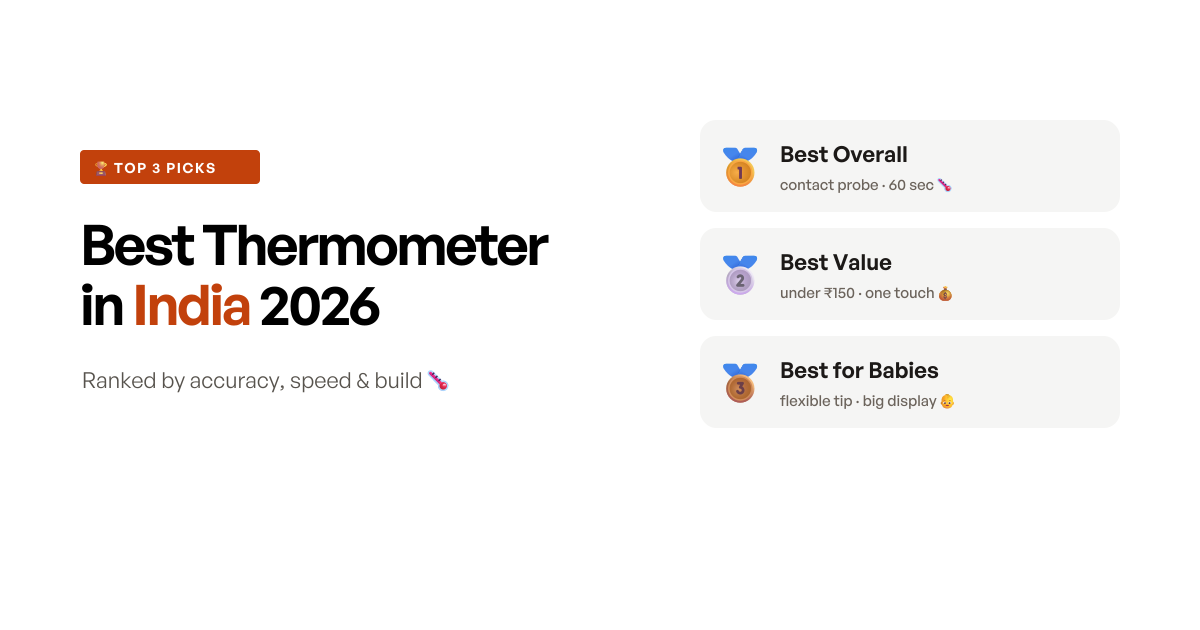
The AccuSure MT-32 wins for a reason that sounds like faint praise until you read enough thermometer reviews: its owners complain about how long it takes, not about whether the number is right. In this category that is the whole game, and almost nothing else here clears it. It costs ₹227, reads in a genuine sixty seconds, and is honest about that on the box. If you are taking readings on a small child, the Carent DMT4326 and its soft flexible tip is the better ₹299, as long as you accept that its advertised ten-second reading is really about a minute.
Quick comparison
Six thermometers side by side, with the number the listings work hardest to obscure - how long you will actually stand there waiting.
- 8.5 scoreBest overall
AccuSure MT-32 Mercury-Free Digital Thermometer
The one thermometer here where owners argue about how long it takes rather than whether the number is right. Rs227, 60 seconds, and it says so on the box.
Read the reviewapprox. ₹227 - 8.1 scoreBest under Rs150
AmbiTech PHX-01 Digital Thermometer
Rs149 for a Chennai-made probe that most owners get a working reading out of. Keep a spare cell in the case and it earns its keep.
Read the reviewapprox. ₹149 - 7.9 scoreBest for babies and toddlers
Carent DMT4326 Waterproof Flexible Tip Digital Thermometer
A soft rubberised tip and the biggest display here, built for a child who will not hold still. Ignore the ten-second claim; budget a minute.
Read the reviewapprox. ₹299 - 7.8 scoreBest for older eyes
HICKS MT-401 FastRead Digital Thermometer
A fever-line indicator that colours the answer instead of making you interpret it, from the Indian company whose mercury thermometer was in every first-aid box.
Read the reviewapprox. ₹207 - 7.6 scoreBest spare
Dr. Morepen MT-100 Digital Thermometer
Rs135 from a brand every chemist in India stocks. The right second thermometer, and a risky only one.
Read the reviewapprox. ₹135 - 7.1 scoreBest non-contact
Dr. Odin OIR003 Non-Contact Infrared Thermometer
The least-bad infrared gun here, and the only one with an ear mode worth using. Screening tool, not a diagnosis.
Read the reviewapprox. ₹1,199
How we shortlisted
Almost every buying guide in this category is organised around a false upgrade path: cheap stick, better stick, then the infrared gun that reads in a second without touching anyone. We researched twenty thermometers on that ladder and the ladder runs the wrong way. The seven non-contact infrared devices we scraped produced, without exception, the worst owner reviews of anything here - on the two most expensive of them, more than three quarters of recent verified reviews were a single star, overwhelmingly about readings that did not match a contact thermometer in the same house. Meanwhile the ₹149 probe from Chennai has two-thirds of its owners satisfied. Price and quality are genuinely inverted here, and any list that puts an infrared gun at the top has not read the reviews.
There is a physical reason for that, not just a manufacturing one. A forehead scan measures skin, and skin temperature moves with the room, with sweat, with how long the device has been sitting somewhere warm. A 2022 study in Children put numbers on it: non-contact forehead thermometers detected fever in children with a sensitivity of 0.81 , falling to 0.66 in the under-sixes, and the authors’ conclusion was that any elevated reading needs confirming on a different type of thermometer. A device that sends you to a second device is not the top of a ladder.
So we ranked on whether owners get a number they can act on, and everything else came second. The spec that we treated as actively adverse was advertised reading time. Devices claiming ten seconds get timed by their owners at sixty to ninety; the AccuSure claims sixty and delivers sixty, and that honesty correlates with the rest of the product. The failure mode that moved rankings most was not the sensor at all - it was the button cell, which drains unnoticed in a drawer and surfaces as a blank screen at 2am. That is why one of these six picks exists purely to be your second thermometer. The same pattern of blaming a device for a technique problem shows up in home blood pressure monitors , and it is worth reading how to hold one of these before deciding yours is broken.
The six that survived cover genuinely different jobs - the reliable default, the cheap one to duplicate, the flexible tip for a baby, the interpreted reading for an older parent, the spare, and the one non-contact device we would let into the house. We dropped the category’s best-selling flexible-tip probe to get there, and we would rather explain that than pad the list.
At a glance: 6 thermometers, what each one is good for
| Thermometer | Price | Real reading time | Tip | Warranty | Best for |
|---|---|---|---|---|---|
| AccuSure MT-32 | ₹227 | 60 sec (as advertised) | Rigid | 1 year | The reliable default for most homes |
| AmbiTech PHX-01 | ₹149 | 60 sec | Rigid | 1 year (per listing) | Buying two, or a second household |
| Carent DMT4326 | ₹299 | 45 to 90 sec | Flexible, waterproof | 5 years (claimed) | Babies and toddlers |
| HICKS MT-401 | ₹207 | 60 to 90 sec | Rigid, water-resistant | 1 year | An older parent who wants the answer read for them |
| Dr. Morepen MT-100 | ₹135 | Slow, per owners | Rigid | 6 months | The spare in the travel bag |
| Dr. Odin OIR003 | ₹1,199 | 1 sec | None - infrared | 6 months | A fast first look at a sleeping child |
The 6 picks, reviewed
1. AccuSure MT-32 - best all-round thermometer
Read enough thermometer reviews and you learn to sort the complaints into two piles. One pile is about the experience: it is slow, it is bulky, the case is flimsy, the button is stiff. The other pile is about the number: it says 96 on a well person, it disagrees with the other thermometer in the house, it showed 98 while my son had 101. The first pile is annoyance. The second pile means the device has failed at its only job. What separates the AccuSure MT-32 from everything else we researched is that its complaints land almost entirely in the first pile.
That is not the same as saying it is a lovely thing to own. It is bulkier and heavier than the HICKS or the AmbiTech, several owners say so, and the transparent storage case is visibly the cheapest component - more than one person rated the case badly while rating the thermometer fine. Sixty seconds is a long minute, and one owner described the specific problem exactly: the child gets restless before it beeps. The on/off button wants a firmer press than it should.
But sixty seconds is also what it says on the box, and in this category that is close to a moral position. Both the HICKS and the Carent advertise a ten-second reading and their owners measure a minute and a half. A thermometer that tells the truth about the boring number tends to be telling the truth about the important one, and here it is: the display is large and bold enough that owners single it out unprompted, there is a real manufacturer behind it in Microgene Diagnostic Systems with a published customer care number, and the warranty runs a year from purchase. A small minority report it reading about a degree low, which is the standing advice for any thermometer here - check it against something you trust in the first week, while you can still send it back.
Key specifications
- Reading time
- 60 seconds
- Range
- 89 to 109.9 degrees Fahrenheit
- Resolution
- 0.1 degrees
- Scales
- Celsius and Fahrenheit
- Battery
- LR41, preinstalled and user-replaceable
- Length
- 13 cm
- Standard
- CE marked, mercury-free
- Warranty
- 1 year manufacturer, non-transferable
Pros
- Across the recent verified reviews we read, this had the smallest share of owners reporting a wrong or absent reading of anything in the category - and unlike almost every rival, its critics complain about the wait rather than the number
- The 60-second readout is honest. The Carent and the HICKS both advertise a ten-second reading and their owners measure 60 to 90 seconds; buying a thermometer that tells you the truth on the box is worth more than it sounds
- Owners repeatedly single out the display - one called out the bold lettering specifically - which matters more than any spec when the person taking a reading at 3am is half asleep
- A named Indian manufacturer with a published customer care number and a 1-year warranty, rather than a brand that exists only as a logo on a listing
Cons
- Sixty seconds is a genuinely long time to hold a probe under a toddler's arm, and one owner said exactly that - the child gets restless before it beeps
- It is noticeably bulkier and heavier in the hand than the AmbiTech or the HICKS, which several owners mention unprompted
- The storage case is the cheap part - more than one owner rated the case itself as poor quality while rating the thermometer fine
- A minority report it reading about a degree low, and the on/off button is stiff enough that one owner said it needs more work
Who should buy this
The household that wants one thermometer in the medicine drawer that will still give a believable number the next time somebody spikes a fever, and does not care about colour screens or one-second readings. It suits a home with adults and school-age children rather than infants: sixty seconds is fine for anyone who can sit still, the display is legible across a room, and there is a real manufacturer to call if it fails inside the year.
Skip if
Skip if you are taking readings on a squirming one-year-old, because sixty seconds of a rigid probe under an arm is a fight you will lose most nights - the Carent DMT4326 has a soft flexible tip built for exactly that.
Ready to buy?
AccuSure MT-32 Mercury-Free Digital Thermometer
2. AmbiTech PHX-01 - best under ₹150
At ₹149 this changes the question from which thermometer to buy into how many. It is made in Maduravoyal in Chennai by a company with a full printed address, which puts it ahead of most of the sub-₹200 shelf on provenance alone, and roughly two-thirds of its recent verified owners rate it four or five stars - a share that sits close to the AccuSure at two-thirds the price. What they say about it is refreshingly proportionate: small, quick enough, accurate enough for working out whether somebody has a fever, build quality that one owner rated honestly as ok-ok.
The fault is the battery, and it is specific rather than general. Owners report a low-battery indicator that comes on and stays on through a fresh cell; one buyer who ordered six units found four of them with flat batteries out of the box; another had it stop reading entirely after nine or ten days. That is not a device that dies gracefully at two years, it is a device with a meaningful early-failure rate, and the return window is your protection against it. Switch it on the day it arrives.
Which is why this pick is framed the way it is. At ₹149 the sensible response to a device with an early-failure rate is not to buy a better one, it is to buy two. That covers the actual risk - a flat cell on the night you need a reading - far more effectively than spending ₹1,199 on an infrared gun with worse reviews. Tape a spare LR41 inside the case and this is the most cost-effective thing in this review.
Key specifications
- Reading time
- 60 seconds
- Scales
- Celsius and Fahrenheit, with last-reading memory
- Use
- oral or underarm, adult and child
- Battery
- LR41 button cell
- Length
- 15.2 cm
- Auto shut-off
- yes
- Manufacturer
- AmbiTech Healthcare Pvt Ltd, Maduravoyal, Chennai
- Warranty
- 1 year per listing
Pros
- At ₹149 it is the cheapest device here that most owners actually get a usable reading from - the positive share in its recent reviews sits close to the AccuSure at two-thirds the price
- Genuinely made in India by a company with a printed Chennai address, which is more than most of the sub-₹200 shelf can say
- One-touch on, a beeper at the end and automatic shut-off, so there is no menu and nothing to configure before you can use it
- The owners who like it describe it in the right terms - small, accurate enough for home diagnosis, quick - rather than claiming clinical precision it does not have
Cons
- The battery is the signature failure. Several owners report a permanent low-battery indicator that survives a fresh cell, and one who bought six units found four with flat batteries out of the box
- The build feels like ₹149 - owners who rate it well still describe the construction as ok-ok rather than solid
- One owner had it stop giving readings entirely after nine or ten days, which is the pattern to watch for in the first fortnight
- Sixty seconds, no fever-line indicator, no backlight - this is a bare number on a small screen and nothing else
Who should buy this
Anyone who wants a working thermometer in the house without thinking about it, and anyone buying more than one - for a parent's flat, a second home, a hostel room. At ₹149 the honest strategy in this category is redundancy rather than premium, and this is the unit that makes that strategy cheap. Buy two, keep a spare LR41 taped inside one case, and you have covered the failure mode that actually happens.
Skip if
Skip if this will be your only thermometer and nobody in the house will think to test it between fevers, because its low-battery fault is the kind you discover on the night you need it - the AccuSure MT-32 has the steadier record for a single-unit household.
Ready to buy?
AmbiTech PHX-01 Digital Thermometer
3. Carent DMT4326 - best for babies and toddlers
Everything good about this thermometer is aimed at a specific problem: getting a reading out of somebody who does not want to give you one. The tip is soft rubberised rather than rigid plastic, so it bends when a child clamps down or squirms instead of poking them, and the body is genuinely waterproof rather than splash-resistant, which means it can be properly washed when it moves between two sick children in the same week. The display is the biggest in this review by some margin, and owners keep saying so - the recurring phrasing is that it is clearly bigger and easier to read than other digital thermometers they have owned, with a build that feels solid rather than disposable.
The result is the highest share of unreserved five-star reviews of anything here, and crucially those reviews come from parents describing readings taken on infants rather than from people admiring a spec sheet.
Now the honest part. The listing’s reading time is not real. One owner timed 90 seconds against a claimed 30; another logged 45 to 60 seconds against a claimed 10 and still rated it four stars, describing it as a good sturdy product that simply takes longer than advertised. Buy it expecting a minute. At 19 cm it is also the longest device here, which a couple of owners found unwieldy rather than reassuring, and the five-year warranty in the feature block has no manufacturer warranty statement behind it - treat that as marketing. Several people opened the box to a corroded or flat cell, which by now you will recognise as this category’s signature.
Key specifications
- Tip
- flexible rubberised, waterproof
- Reading time
- 45 to 90 seconds in practice (listing claims faster)
- Range
- up to 42.9 degrees Celsius
- Resolution
- 0.1 degrees
- Scales
- Celsius and Fahrenheit, hold the button five seconds to switch
- Battery
- LR44 button cell
- Length
- 19 cm
- Standards claimed
- CE and FDA
Pros
- The flexible tip is the whole point and it works - it bends under pressure instead of poking, which is the difference between an underarm reading and a screaming match
- Properly waterproof rather than splash-resistant, so you can actually wash it between children instead of wiping it and hoping
- Owners consistently call out the display as bigger and clearer than other digital thermometers they have owned, and the build as solid rather than flimsy
- It draws the highest proportion of unreserved five-star reviews of anything in this review, overwhelmingly from parents using it on small children
Cons
- The advertised reading time is fiction. One owner timed 90 seconds against a claimed 30, another 45 to 60 against a claimed 10, and both still rated it positively - but buy it knowing that
- At 19 cm it is the longest device here, and a couple of owners found the size unwieldy rather than reassuring
- The listing advertises a five-year warranty in its feature block with no manufacturer warranty statement behind it, so treat that number as marketing rather than a commitment
- Several owners opened the box to a corroded or flat cell, and one received a different colour from the one ordered
Who should buy this
Parents of anyone under about five, and households where a thermometer gets passed between sick children in the same week. The soft tip and the washable body are both aimed squarely at that use, and the review body backs it up - the people rating this highest are describing readings taken on infants and toddlers, not on themselves. The oversized display helps at night when you are reading it one-handed.
Skip if
Skip if you were buying it for the ten-second reading on the listing, because it does not do that and never has - if speed genuinely matters more than the flexible tip, the AccuSure MT-32 at least tells you the truth about its sixty seconds.
Ready to buy?
Carent DMT4326 Waterproof Flexible Tip Digital Thermometer
4. HICKS MT-401 - best for older eyes
If you have ever tried to talk a parent through a thermometer reading over the phone, you already know the actual problem. It is not that they cannot see the digits. It is that 99.8 does not mean anything to somebody who does not carry fever thresholds around in their head, so the number gets reported to you and you become the interpreter. The fever-line indicator on the MT-401 solves that directly by marking the reading as normal, mild or high, and it is the reason this sits above several cheaper probes that measure just as well.
The brand matters here too, in a way it rarely does. HICKS Thermometers has been making clinical thermometers in India for decades, and for anyone over about sixty the name on the case is the one from the glass mercury thermometer in the old first-aid tin. The 1-year warranty is stated plainly rather than claimed in a feature bullet, and owners cite it approvingly. At 10 g it is also the lightest thing in this review, which sounds like a trivia point until you are holding it under a sleeping parent’s arm for a minute.
That minute is the first problem. The listing says ten seconds; owners time 60 to 90, and one logged a minute and a half specifically against the claim. The second is stranger and more annoying: the packaging promises both Celsius and Fahrenheit, and a real number of units arrive giving only Fahrenheit, with one owner pointing out the contradiction on the box itself. Changing the battery is fiddly enough that people mention it unprompted. And its accuracy complaints, while nowhere near infrared territory, are more common than the AccuSure’s - which is what keeps it fourth rather than first.
Key specifications
- Fever-line indicator
- visual normal / mild / high
- Range
- 90 to 109.9 degrees Fahrenheit
- Resolution
- 0.1 degrees
- Memory
- last reading recalled automatically
- Battery
- included, user-replaceable
- Weight
- 10 g
- Length
- 13 cm
- Warranty
- 1 year
Pros
- The fever-line indicator is the feature that justifies this over a plain probe: a reading of 99.8 means nothing to somebody who does not track these numbers, and a marked band does
- HICKS has made clinical thermometers in India for decades, which is a real service and warranty proposition rather than a badge - the 1-year cover is stated plainly and owners cite it approvingly
- At 10 g it is by far the lightest device here, which sounds trivial until you are holding it under a sleeping parent's arm
- Water-resistant and mercury-free with automatic power-off, so it survives being cleaned properly and does not quietly drain itself
Cons
- The ten-second reading on the listing is not real - owners time it at 60 to 90 seconds, and one specifically logged a minute and a half against the claim
- The listing promises both scales but a real number of units arrive locked to Fahrenheit, with one owner pointing out the box says both and the device gives only one
- Changing the battery is awkward enough that owners raise it unprompted
- Accuracy complaints are more common here than on the AccuSure, including owners who found it disagreeing with a second thermometer in the house
Who should buy this
A household buying for an older parent, or for anybody who wants the device to interpret the reading rather than hand over a bare number. The fever-line band is genuinely useful for somebody who does not carry 98.6 and 100.4 around in their head, and the weight makes it the easiest thing here to hold steady for a minute. The familiar Indian brand is not nothing either if the person using it is 70.
Skip if
Skip if you think in Celsius and will be annoyed by a device that might arrive stuck in Fahrenheit despite advertising both - the AccuSure MT-32 draws no such complaints, and switching scales on the Carent is documented on the listing.
Ready to buy?
HICKS MT-401 FastRead Digital Thermometer
5. Dr. Morepen MT-100 - best spare
This one is on the list for a reason that has nothing to do with it being the best at anything. It is ₹135, and ₹135 is what it costs to stop having a single point of failure in your medicine drawer.
The case for it is straightforward. Dr. Morepen sits on the shelf of essentially every chemist in India, so a replacement is a walk rather than a wait - which matters more in Nashik or Guwahati than the spec sheet ever will. A clear majority of recent owners rate it four or five stars, several noting it arrived early with the cell already fitted and working, and it commits to oral, underarm and rectal use where cheaper listings hedge.
The case against it is the same battery story as everything else here, only louder. One buyer received two units and both showed the low-battery symbol from the first press. Another had never used theirs at all and found it flat the first time a child ran a fever, which is precisely the failure this category specialises in. It is slow even by these standards, the six-month warranty is the shortest of anything in this review, and one owner trying to claim it described being passed between forwarding emails rather than getting a replacement.
None of which disqualifies it from the job it is here to do. A spare thermometer does not need a long warranty or a fast reading; it needs to exist, to be somewhere else, and to cost little enough that buying it is not a decision. Two devices that each work most of the time beat one device you have not tested since last winter, and this is the cheapest way to get the second one.
Key specifications
- Use
- oral, underarm or rectal
- Battery
- LR44 button cell, supplied fitted
- Reading
- digital, with completion beep
- Brand
- Dr. Morepen, Morepen Laboratories
- Warranty
- 6 months against manufacturing defects
- Compliance claimed
- FDA
Pros
- At ₹135 it is the cheapest way to own a second thermometer, and a second thermometer is the single most useful thing you can buy in this category - it is how you find out the first one has drifted
- Morepen is on the shelf of essentially every chemist in the country, so if it dies you replace it that afternoon rather than waiting on a courier
- A clear majority of recent owners rate it four or five stars, and several specifically note it arriving early with the cell already inside and working
- It does oral, underarm and rectal, which the cheaper listings often will not commit to
Cons
- A half-dead button cell on arrival is the loudest and most repeated complaint - one buyer received two units both showing low battery from the first press, another found it flat the first time a child had a fever, having never used it
- It is slow even by this category's standards, with several owners calling out a long wait for the reading
- The 6-month warranty is the shortest of any product in this review, and one owner reported being passed between forwarding emails rather than getting a replacement
- A visible minority report it dead within a month or reading wrong by more than half a degree
Who should buy this
Anyone who has read this far and accepted the real lesson of this category, which is that one thermometer is a single point of failure. This is the one to buy alongside your main device and keep somewhere else - the travel bag, the car, a parent's flat - so that a flat cell or a drifting reading is an inconvenience rather than a 2am problem. At ₹135 that redundancy costs less than a strip of paracetamol.
Skip if
Skip if this is the only thermometer in the house, because its battery-on-arrival problem is the most reported of anything here and you will find out at the worst time - spend the extra ₹92 on the AccuSure MT-32 if it has to work alone.
Ready to buy?
Dr. Morepen MT-100 Digital Thermometer
6. Dr. Odin OIR003 - best non-contact
Somebody reading this genuinely does need a no-touch reading. A sleeping infant you would rather not wake, a grandparent with dementia who will not tolerate a probe under the arm, a household checking five people quickly during a viral week. For those jobs this is the device we would allow in, and the bar it cleared to get here was low: of the seven infrared thermometers we researched, it is the only one where a clear majority of recent owners are satisfied. The others range from poor to genuinely alarming.
What it does better than its rivals is offer a real ear mode, and that is the mode to use. An ear reading measures a body cavity rather than skin, which is why it holds up where forehead scans drift with room temperature and sweat. The colour display does the interpreting - green, yellow, red - which is the one honest advantage of this format for a frightened parent at 3am. And it runs on two AAA cells you can change in ten seconds, rather than the coin cell behind a micro screw that turned the Omron MC 720 into a case study in bad design.
It has not escaped the format’s core problem, though, and you should buy it knowing that. One owner logged readings swinging from 91 to 99 degrees Fahrenheit on the same person five seconds apart. Several describe accuracy holding up for a month or two and then falling away. Another measured boiling water at 85 degrees Celsius, which tells you what the calibration is worth outside its narrow body range. The forehead mode needs the device far closer to the skin than “non-contact” implies, and the six-month warranty is the joint shortest here. Use it as a fast first look that tells you whether to go and fetch the real number - which is, near enough, what the clinical literature says it is for.
Key specifications
- Modes
- ear and forehead
- Reading time
- 1 second
- Body range
- 32 to 42.9 degrees Celsius
- Display
- backlit colour, green / yellow / red
- Battery
- 2 x AAA, included
- Auto shut-off
- 10 seconds
- Weight
- 70 g
- Registration claimed
- ISO 13485, NABCB QM 030
- Warranty
- 6 months manufacturer
Pros
- Of the seven non-contact thermometers we scraped, this is the only one where a clear majority of recent owners are satisfied - the rest range from bad to catastrophic
- It has a real ear mode, and an ear reading is measuring a body cavity rather than skin, which is why it holds up where the forehead scan drifts
- The colour display does the interpretation, which is the one genuine advantage of this format for a nervous parent at night
- Two AAA cells you can swap in ten seconds, instead of the coin cell behind a micro screw that made the Omron MC 720 a byword for battery misery
Cons
- It still has the format's fundamental problem. One owner logged readings swinging from 91 to 99 degrees Fahrenheit five seconds apart on the same person, and several describe accuracy collapsing around month two
- The forehead mode needs the device far closer to the skin than no-touch implies, which several owners discovered only after doubting the readings
- One owner found it measured boiling water at 85 degrees Celsius, which tells you what its calibration is worth outside the narrow body range
- The 6-month warranty is the joint shortest here, and one owner had a cell jam inside the battery compartment
Who should buy this
Households where a contact reading genuinely is not practical - a sleeping infant you do not want to wake, an elderly relative who will not tolerate a probe, a house checking several people quickly during a viral week. Buy it as the fast first look that tells you whether to go and get the real number, use the ear mode rather than the forehead one, and keep a contact thermometer for anything you intend to treat.
Skip if
Skip if you want one thermometer to make treatment decisions on, because the published clinical guidance says an elevated non-contact reading should be confirmed on a contact device anyway - buy the AccuSure MT-32 and save yourself ₹972.
Ready to buy?
Dr. Odin OIR003 Non-Contact Infrared Thermometer
The features explained, in plain English
Contact versus non-contact. A contact thermometer puts a thermistor against your body and waits for the two to reach the same temperature, which is why it takes a minute. A non-contact infrared thermometer reads the heat radiating off your skin from a few centimetres away and calculates backwards to a body temperature. The first measures you. The second measures your surface and estimates you, which is why a hot room, a sweaty forehead or a device that has been sitting in the sun all change the answer. Neither is exotic technology; the difference is what they are physically able to know.
Reading time, and why the advertised number is usually wrong. A contact probe reaches equilibrium when it stops climbing, and on a human armpit that takes roughly a minute. Devices that beep at ten seconds are either extrapolating from the rate of rise or simply beeping early, and extrapolation is where low readings come from. The AccuSure quoting sixty seconds is not a worse specification than the HICKS quoting ten - it is the same measurement, described honestly.
Resolution versus accuracy. Every device here displays to 0.1 degrees, and that number tells you nothing about whether it is right. Resolution is how finely the screen can express an answer; accuracy is how close that answer is to your actual temperature. A thermometer reading 98.3 when you are at 100.2 is displaying wrong to one decimal place. When a listing leads with 0.1-degree precision and says nothing about tolerance, it is advertising the easy number.
The fever-line indicator. A visual band or colour that marks the reading as normal, raised or high, so the person holding it does not need to remember that a fever starts around 100.4 degrees Fahrenheit or 38 degrees Celsius. It is not a measurement feature and it adds no accuracy, but for an older user taking their own temperature it converts a number into a decision, which is the actual job.
Button cells, and why they matter more than the sensor. These devices run on LR41 or LR44 coin cells that cost a few rupees and hold enough charge for hundreds of readings. The problem is not capacity, it is time: a cell sitting in a drawer for eight months self-discharges, and the thermometer that worked last winter shows a low-battery symbol on the night you need it. This is the single most common failure across every brand in this review, and it is entirely preventable.
Complete buying guide
How much should you actually spend on a thermometer?
The honest answer is that the useful range is narrow and the top of the market is a trap. Here is how the money maps to what you get:
- ₹130 to ₹160 - basic contact probes from Dr. Morepen, AmbiTech and similar. These work, most of the time, from named manufacturers. The right money for a second or third unit.
- ₹200 to ₹300 - the sweet spot. AccuSure, HICKS and Carent all sit here, and this is where you get a proper display, a fever indicator or a flexible tip, and a warranty from someone you can actually reach.
- ₹1,000 to ₹1,800 - non-contact infrared. You are paying six to twelve times the price for a reading the clinical guidance says you should confirm on a contact device anyway, and this tier has the worst owner reviews in the category.
- Above ₹4,000 - almost always a grey import. The Braun ThermoScan listing we looked at was ₹11,800 with practically no Indian reviews behind it.
The corollary is the most useful advice in this review: if you have ₹400 to spend, buy two ₹200 thermometers rather than one ₹400 one. Redundancy solves the failure that actually happens to people. A slightly better sensor does not.
Specs that matter, specs that don’t
Three things decide this purchase. Contact or infrared decides whether you can act on the reading. The tip decides whether you can get a reading out of a child at all - flexible if there is anyone under five in the house. The display decides whether the person taking the reading can use it without calling you, which is where the fever-line band earns its keep.
Three things are noise. Advertised reading time is worse than noise, because in this category it correlates negatively with honesty. Memory recall of the last reading sounds useful and is almost never used; you write the number down or you do not. And 0.1-degree resolution is on every single product here, so it distinguishes nothing - when a listing leads with it, that is a tell.
Service network reality check
There is no service network in this category, and it is worth saying plainly rather than pretending otherwise. Nobody repairs a ₹200 thermometer. What the warranty actually buys you is a replacement, and that only works if the brand is reachable - which is where the difference between a manufacturer and a marketplace logo shows up. AccuSure publishes a customer care number for Microgene Diagnostic Systems, HICKS is an established Indian thermometer manufacturer, and Dr. Morepen is a pharmaceutical company you could complain to. Several products we scored below the line have no identifiable manufacturer at all.
The practical substitute for a service network is the chemist. Dr. Morepen, HICKS and AccuSure are all stocked in physical pharmacies across small-town India, so a dead unit is replaced the same afternoon at retail price rather than through a courier and a claim. That matters far more here than warranty length: a six-month warranty on something you can buy over a counter in Jhansi is worth more than five years from a brand whose only address is a listing. The same logic drove our pick order for home glucometers , where the consumable supply chain outranks the device.
When to buy, and when the sale price is a trap
There is no product cycle here worth waiting for. Thermometer designs barely change, and the units on sale in 2026 are largely the ones that were on sale in 2022. Buy when you need one, which realistically means buy one now, before you need one, because the day you need a thermometer is not a day you want to spend comparing listings.
The one timing trap is stock age. Because these devices sit in warehouses for years, the button cell inside can be substantially discharged before it ever reaches you, and the deeper the discount the more likely you are looking at old stock. One Beurer owner found a unit manufactured in 2020, imported in 2022 and sold to them in 2025. A festival-sale price on a thermometer is not the bargain it looks like if the cell is four years into its shelf life - which, again, argues for buying a spare cell alongside.
What we don’t recommend, and why
The entire non-contact infrared tier, with one exception. This is the strongest finding in this review. The Omron MC 720 at ₹1,799 has no off switch, drains its cell in weeks, and hides the battery behind a screw too small for a normal driver - roughly three quarters of its recent verified reviews are one star. The Beurer FT 65 at ₹1,720 is worse still, and owners repeatedly report that its advertised five-year warranty could not be claimed. The Beurer FT 85 and the HealthSense Accu-Scan are both dominated by accuracy complaints, several from parents who compared them against a contact reading and found gaps of two to four degrees. Dr Trust’s forehead model draws the same pattern. Only the Dr. Odin cleared our bar, and even that is a screening device.
The Dr Trust 604 flexible-tip probe, which is one of the best-selling thermometers on Amazon India and did not make this list. A large minority of its recent owners report it reading around 96 degrees Fahrenheit on a healthy person, several after a replacement unit did the same. Reading consistently low is the most dangerous failure a thermometer can have, because it does not look like a failure - it looks like good news.
The Omron MC 246, the default recommendation in this category for a decade, which we could not include for a simpler reason: it had no buy-box price on Amazon India when we checked, so there is no honest price to quote you. Its recurring complaint is also worth knowing - owners repeatedly cannot switch it from Celsius to Fahrenheit despite the manual’s instructions.
The Braun ThermoScan 5 ear thermometer at ₹11,800. The device has a good global reputation, but that listing is a grey import: one lone Indian review, with the rest of the review body written in German, French, Italian and Spanish by buyers on other marketplaces. There is no Indian warranty behind it, and the price is roughly ten times what an ear reading should cost you here.
The BPL Accudigit F4, which we scraped and then had to discard, because its review body is pooled with BPL’s DT-04 contact thermometer - identical text, identical count. There is no way to judge the F4 on evidence that belongs to a different product.
Frequently asked questions
Which is the best thermometer in India in 2026?
The AccuSure MT-32, at around Rs227. It is not the most modern-looking device in this category and it is not the fastest, but it is the only one we researched where the recurring owner complaint is about how long it takes rather than whether the number is right - and that is the only distinction that matters in a thermometer. It reads in a genuine 60 seconds, has a large display, and carries a 1-year warranty from a named Indian manufacturer.
Are infrared forehead thermometers accurate?
Accurate enough to screen, not accurate enough to treat on. A 2022 study in Children found non-contact forehead thermometers detected fever in children with a sensitivity of 0.81 overall, dropping to between 0.66 and 0.76 in children under six, and the authors concluded plainly that a reading above 38 degrees Celsius needs a secondary check on a different type of thermometer. That matches what owners report: readings that move by two or three degrees Fahrenheit between takes seconds apart. If a device sends you to a second device before you can act, the second device is the one to buy.
Why does my digital thermometer show 96 degrees when I feel fine?
Usually technique, sometimes the device. Underarm readings run roughly a degree Fahrenheit below oral ones and need the probe in full skin contact with the arm held down for the whole measurement, and a probe that has been sitting in an air-conditioned room needs a moment to settle. But if a thermometer consistently shows 93 to 96 on a well person no matter how you take it, that is the device - it is one of the most common complaints in this category, and it is why we dropped the category's best-selling flexible-tip probe from this list.
How do I change a digital thermometer from Celsius to Fahrenheit?
On most of these devices you hold the on/off button down for about five seconds with the thermometer switched off, which is what the Carent listing documents and what BPL owners eventually worked out for themselves. The uncomfortable truth is that it does not always work: units arriving locked to a single scale is one of the most repeated complaints across every brand here, including HICKS and Beurer. Test the switch the day it arrives, while you can still return it.
Which thermometer is best for a newborn or a toddler?
A flexible-tip contact thermometer, and of the ones here the Carent DMT4326 at around Rs299. The soft tip bends instead of jabbing, the body is properly waterproof so it can be washed between children, and it has the largest display in this review. Do not buy a forehead infrared for a baby on accuracy grounds - the published sensitivity for detecting fever is at its worst in children under six, which is exactly the group you would be buying it for.
How long should a digital thermometer take to read?
Sixty seconds, and be suspicious of anything claiming less. Both the HICKS MT-401 and the Carent DMT4326 advertise a ten-second reading and their owners consistently time 45 to 90 seconds; the AccuSure MT-32 advertises 60 seconds and takes 60. A thermometer that beeps too early has not settled, which is a real source of readings that come in low. The honest devices in this category are the ones that do not pretend.
Is a mercury thermometer more accurate than a digital one?
A glass mercury thermometer is a genuinely stable instrument and plenty of Indian households still trust theirs more than anything on this list, which the reviews reflect - owners repeatedly cross-check a digital against the old mercury one and side with the mercury. But mercury thermometers take three to five minutes, break, and are being phased out of medical use worldwide on toxicity grounds. The practical answer is a decent contact digital, cross-checked once against something you trust when you first buy it.
How much should I spend on a thermometer in India?
Between Rs130 and Rs300, and buy two rather than one expensive one. Everything worth owning in this category sits in that band. Spending Rs1,200 to Rs1,800 buys you an infrared gun that the clinical guidance says you should confirm on a contact thermometer anyway, and the owner reviews on those devices are the worst in the category by a wide margin.
Why did my thermometer stop working after a few months?
Almost always the button cell. This is the dominant failure across every brand here, and it has a specific shape: the device sits unused in a drawer for eight months, the LR41 or LR44 slowly drains, and the fault surfaces as a low-battery symbol or a blank screen on the night somebody has a fever. Buy a strip of spare cells with the thermometer, keep one taped inside the case, and switch the device on once every few months to check it.
Should I buy an ear thermometer instead?
An ear reading is a better measurement than a forehead scan because it reads a body cavity rather than skin, and the Dr. Odin OIR003 offers one at around Rs1,199. What we would avoid is the imported ear thermometer route - the Braun ThermoScan listing on Amazon India was priced at Rs11,800 when we checked, has almost no Indian reviews, and its review body is overwhelmingly from German, French and Italian buyers. That is a grey import with no local warranty, at four figures more than a device that does the same job.
What should I check the day a thermometer arrives?
Three things, all within the return window. Switch it on and confirm the battery is not already showing low, because arriving with a half-flat cell is the single most reported delivery problem in this category. Switch it between Celsius and Fahrenheit and confirm both work. And take your own temperature and somebody else's, then take them again ten minutes later - two readings a degree or more apart on a well person means send it back now, not in three months when you actually need it.
Can one thermometer be used for the whole family?
Yes, if you clean it between people, which is a real argument for a waterproof body like the Carent DMT4326 that can be washed rather than wiped. Use the underarm route rather than oral if it is being shared during an infectious week, and keep separate devices for anybody being monitored regularly. This is also the practical case for owning two cheap thermometers rather than one expensive one.
The bottom line
Buy the AccuSure MT-32 at ₹227 and a Dr. Morepen MT-100 at ₹135 to keep somewhere else, and you have solved this category for under ₹400. If there is a child under five in the house, swap the AccuSure for the Carent DMT4326 and its flexible tip. If you are buying for a parent who will be taking their own readings, the HICKS MT-401 and its fever-line band is worth the ₹207. If you need several units, the AmbiTech PHX-01 at ₹149 is the one to duplicate. And if you genuinely need no-touch, the Dr. Odin OIR003 is the least-bad infrared device here - use its ear mode, and confirm anything alarming on a contact probe.
We will revisit this list around the festival sales, when the infrared tier discounts hardest and the temptation to recommend one is at its strongest.