
Best Smart TV in India 2026
The best smart TV in India isn't a single set - it's the right panel for your room and budget. We read the verified reviews across the brands Indians actually shop and picked six that hold up, from a ₹22,000 budget 4K QLED to a ₹62,000 Sony.
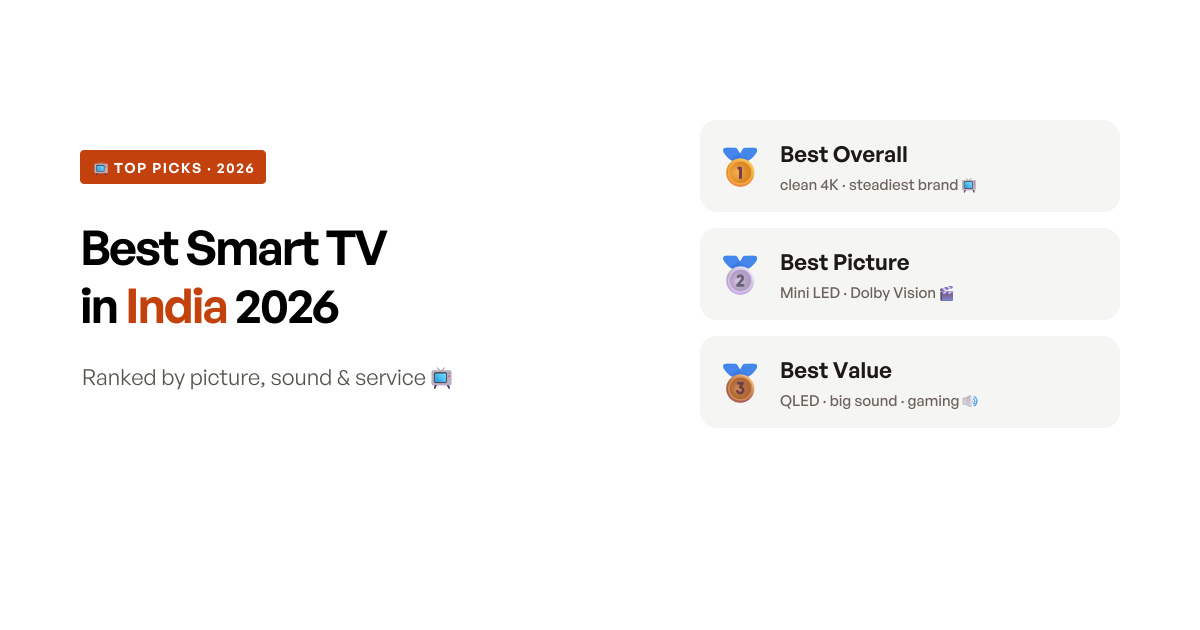
The quick answer
The best smart TV in India is the Sony BRAVIA 2 K-55S25BM2 - it has the cleanest upscaling and motion of any set here, and the steadiest brand reliability, which is what the premium pays for. But at nearly ₹62,000 it’s also an edge-lit, HDR10-only panel with weak 20W sound and no table stand in the box, so it’s the right answer only if your budget genuinely reaches it.
For almost everyone else, the smart money sits between ₹22,000 and ₹53,000, and which set wins depends on what you care about. The Samsung D Series 43-inch is the smoothest big-brand TV to live with; the TCL 55Q6C QD-Mini LED is the best picture for the money; the Vu Vibe is the best sound, with an 88W soundbar built in; the VW Pro 43-inch is the cheapest genuine 4K QLED; and the Xiaomi FX Pro is the cheapest 55-inch, for a Prime household.
Quick comparison
Six picks side by side - the use case each one wins, the price, and a Buy button for the impatient.
- 9.0 scoreBest overall
Sony BRAVIA 2 K-55S25BM2 4K Google TV
The best picture processing and steadiest brand here - if your budget clears the QLED crowd.
Read the reviewapprox. ₹61,990 - 8.7 scoreBest big-brand smart experience
Samsung D Series 43 inch Crystal 4K (UA43DUE80)
The smoothest interface here on a recognisable brand - bright Crystal panel, solar remote.
Read the reviewapprox. ₹29,999 - 8.6 scoreBest picture
TCL 55Q6C 4K QD-Mini LED Google TV
The real HDR step-up here - Mini LED local dimming and Dolby Vision, for less than the Sony.
Read the reviewapprox. ₹52,990 - 8.5 scoreBest sound
Vu Vibe 43VIBE-DV 4K QLED Google TV
An 88W integrated soundbar and Dolby Vision QLED - the most TV-for-money here.
Read the reviewapprox. ₹26,490 - 8.2 scoreBest budget 4K
VW Pro Series 43 inch 4K QLED Google TV (VW43GQ2)
The cheapest genuine 4K QLED here - a lot of panel for around ₹22,000, with a service gamble.
Read the reviewapprox. ₹21,999 - 8.0 scoreBest for Prime / Fire TV
Xiaomi FX Pro QLED 4K Fire TV 55 inch (L55MB-FPIN)
The cheapest 55-inch QLED here, with Fire TV baked in for a Prime household.
Read the reviewapprox. ₹37,999
How we shortlisted
This is our flagship smart-TV pick, so we cast wide: rather than rank one screen size, we read the verified reviews across the brands and budgets Indians actually shop - from ₹22,000 budget QLEDs to a ₹62,000 Sony - and picked the six that hold up, across both the mainstream 43-inch and 55-inch sizes. Anything that didn’t clear our bar was dropped.
The headline that misleads most buyers is the “QLED” badge. QLED is a colour film, not a contrast upgrade - it does nothing on its own to make the picture deeper. At a flagship level the variable that actually decides picture quality is the backlight: an edge-lit LED panel (even the ₹62,000 Sony) can’t dim one part of the screen independently, a QLED adds colour on top of that, and a Mini LED with hundreds of local-dimming zones (the TCL’s 512-plus) is a genuinely different class of HDR. 4K itself is the floor now, not a feature - every set here has it. So we weighted the backlight, the HDR format and the interface speed over the marketing.
Two failure modes moved the rankings more than any spec. The first is panel reliability in year one, and it shows up across every price tier in the reviews - dust inside the panel, black patches and lines at six to nine months, backlight bleed, dead boards - which is why we weighted “buy it sold-and-shipped-by-Amazon and film the unboxing” as heavily as the spec sheet. The second is after-sales, and here the reviews overturn the usual assumption: the premium badge is not automatically safer. The steadiest brand turned out to be Sony, while two popular premium sets - an LG NanoCell and a Samsung QLED - draw heavy panel-and-service complaints and didn’t make the list. That’s why the six picks each cover a distinct buyer rather than just stacking up by price.
At a glance: 6 picks, what each one is good for
| TV | Size | Panel / backlight | HDR | Sound | Smart OS | Price (approx.) |
|---|---|---|---|---|---|---|
| Sony BRAVIA 2 | 55 inch | 4K edge-lit LED, 60Hz | HDR10 | 20W | Google TV | ₹61,990 |
| Samsung D Series | 43 inch | 4K Direct LED, 50Hz | HDR10+ | 20W | Tizen | ₹29,999 |
| TCL 55Q6C | 55 inch | 4K QD-Mini LED, up to 144Hz | Dolby Vision | 40W | Google TV | ₹52,990 |
| Vu Vibe | 43 inch | 4K QLED, 60Hz | Dolby Vision | 88W | Google TV | ₹26,490 |
| VW Pro | 43 inch | 4K QLED, 60Hz | HDR10+ | 50W | Google TV | ₹21,999 |
| Xiaomi FX Pro | 55 inch | 4K QLED, 60Hz | HDR10+ | 34W | Fire TV | ₹37,999 |
The 6 picks, reviewed
1. Sony BRAVIA 2 K-55S25BM2 - best smart TV overall
The Sony wins for the reasons that don’t fit on a price comparison. Its 4K Processor X1 with X-Reality PRO gives the cleanest upscaling and the most natural motion of any set here - the kind of picture owners describe simply as “simply superb”, which at this price is the whole point. Even buyers of cheaper sets concede it: a TCL Mini LED owner volunteers in his own review that “Sony is still the king of 4K upscaling”. Around that sits the thing no budget QLED here can match - the steadiest reliability of any pick, where panel failures are the exception rather than a recurring pattern, and where Sony’s own technician diagnoses a fault honestly when one does happen.
It runs Google TV with the full Play Store, carries four HDMI ports (HDMI 2.1, one eARC) - the most of any pick - and adds AirPlay 2 and Apple HomeKit, which no other set here does. For an Apple household, a broadcast-and-sport watcher, or anyone who just wants the safe long-term buy, it’s the obvious choice.
The caveats are real and worth knowing before you spend ₹62,000. The sound is the weak link: 20W with little bass, and more than one owner who loved the picture said the audio needed a soundbar, one noting his decade-old non-smart Sony Bravia had punchier bass. The bigger gripe is the box itself - Sony doesn’t include a table stand and steers you to wall-mount, and the loudest one-star reviews are about exactly that, a sealed set “gathering dust” while the owner waited and installers pushed a paid flexible stand. And for the money it’s an edge-lit, HDR10-only panel with no Dolby Vision, which is why on picture alone the Mini LED below undercuts it. None of that undoes the processing-and-reliability advantage, but it’s why this is a premium pick, not a value one.
Key specifications
- Resolution
- 4K Ultra HD (3840x2160)
- Panel
- Edge-lit LED, 60Hz native
- Processor
- 4K Processor X1, 4K X-Reality PRO, Motionflow XR 100
- HDR
- HDR10, HLG (no Dolby Vision)
- Sound
- 20W, Dolby Atmos / DTS:X
- OS
- Google TV (Play Store)
- Ports
- 4 HDMI (HDMI 2.1, 1 eARC), 2 USB
- Extras
- AirPlay 2, Apple HomeKit, Alexa, Chromecast built-in
- Energy
- 2 Star (186.76 kWh/year)
- Made in India
- Warranty
- 1 year
Pros
- The cleanest upscaling and motion of any pick - owners call the picture 'simply superb', which at this price is the whole point
- The steadiest brand here - panel failures are the exception rather than the recurring pattern, and Sony's own technician diagnoses a fault honestly when one occurs
- Four HDMI ports (HDMI 2.1, one eARC) - the most of any pick - plus AirPlay 2, Apple HomeKit and Alexa
- Smooth Google TV with the full Play Store, on the most reliable brand in this list
- Made in India with a 2-star energy rating that keeps the running cost sane on a 55-inch panel
Cons
- Sound is the weak link - 20W with little bass; one owner noted his decade-old non-smart Sony Bravia had punchier audio
- No table stand in the box - Sony steers you to wall-mount, and the loudest one-star reviews are about exactly that (a sealed set 'gathering dust' while the owner waited)
- Edge-lit and HDR10-only - no Dolby Vision and no local dimming, so the TCL Mini LED out-pictures it on HDR for less
- The priciest pick here by a distance - owners concede the price is 'on the higher side' versus rivals
- Powering on can take a few presses of the remote from cold for some owners
Who should buy this
The buyer whose budget reaches past the QLED crowd and who wants the best picture processing and the steadiest brand reliability of any TV here. If you watch a lot of broadcast and sport, value clean upscaling and motion, run an Apple household (AirPlay 2, HomeKit), or simply want a set you won't be phoning service about, it's the safe long-term buy - just budget for a soundbar and a wall mount.
Skip if
Skip if your budget tops out below ₹50,000 or you want real HDR pop and big built-in sound - it's an edge-lit, HDR10-only set with 20W audio and no stand in the box, and the TCL 55Q6C's Mini LED or the Vu Vibe's 88W soundbar both do more for less.
Ready to buy?
Sony BRAVIA 2 K-55S25BM2 4K Google TV
2. Samsung D Series 43 inch Crystal 4K - best big-brand smart experience
If you want a recognisable brand and the slickest software, the Samsung D Series is the easiest 43-inch here to live with. Its trump card is Tizen: owners repeatedly call it lighter and quicker than Android or Google TV, with one summing it up as “much lighter… boot time is really fast (1s) and navigating is smooth and snappy”. On a budget set, where a sluggish interface is the most common daily irritation, that speed is worth a lot. The Crystal 4K panel backs it up with colour and brightness owners rate highly - “really good and bright even with daylight” is a recurring note - and the solar-cell remote that recharges over USB-C or ambient light is the kind of small touch buyers single out.
At around ₹30,000 it’s the big-brand pick: an extra year of panel warranty, an optical out, AirPlay 2, and a slim AirSlim body that blends into a wall.
What holds it at second is the sound and the service record. The 20W audio runs low - “sound quality and output is low” is the honest owner verdict, so plan on a soundbar for films - and the panel is 50Hz, which gives up the smoother motion of the 120Hz value sets. More important is what happens if something goes wrong: Samsung’s after-sales draws repeated complaints in the reviews, from a remote that failed inside a year to panel issues left unresolved for months, and there’s a clear DOA / old-stock risk, with one owner warning to do a white-screen test the moment it arrives. Buy it sold-and-shipped-by-Amazon, run that test on unboxing, and it’s the most polished everyday TV here.
Key specifications
- Resolution
- 4K Ultra HD (3840x2160)
- Panel
- Direct LED, 50Hz, matte, UHD Dimming
- HDR
- HDR10+, HLG (no Dolby Vision)
- Processor
- Crystal Processor 4K, Dynamic Crystal Color
- Sound
- 20W, Object Tracking Sound, Q-Symphony, Adaptive Sound
- OS
- Tizen, 8GB storage, solar/USB-C remote
- Ports
- 3 HDMI (1 eARC), 2 USB, optical out
- Extras
- AirPlay 2, SmartThings / Matter hub, Bixby + Alexa
- Energy
- 155.49 kWh/year
- Made in India
- Warranty
- 1 year + 1 year on panel
Pros
- The smoothest smart interface in this list - Tizen is lighter than Android/Google TV, with owners reporting a roughly one-second boot and snappy navigation
- Bright enough to fight daylight - a recurring note is that the Crystal panel stays clear and vivid even in a sunlit room
- Solar-cell remote that recharges over USB-C or ambient light - owners single it out as a genuinely useful touch
- Big-brand backing with an extra year of panel warranty, an optical out and AirPlay 2 - and the slim AirSlim body blends into a wall
- Dynamic Crystal Color and HDR10+ give natural, vivid colour for the price
Cons
- Sound is the weak point - 20W stereo that owners say runs low; plan on a soundbar for films
- A 50Hz panel - fine for OTT and broadcast, but it gives up the smoother motion of the 120Hz value sets
- Samsung's after-sales draws repeated complaints - unresolved panel issues and a remote that failed inside a year both show up in the reviews
- A real DOA / old-stock risk - more than one owner received a defective or bent panel and advises a white-screen test on unboxing
- Only three HDMI ports and no Dolby Vision; some owners wish for more onboard RAM
Who should buy this
The buyer who wants a recognisable big brand and the slickest software over chasing premium HDR. Tizen's speed, the bright Crystal panel and the solar remote make it the easiest 43-inch to live with day to day, and the extra panel-warranty year and Samsung's service footprint are reassuring - best bought sold-and-shipped-by-Amazon with a white-screen test on unboxing so an old-stock panel is an easy swap.
Skip if
Skip if you watch a lot of fast sport or HDR film - the 50Hz panel and 20W sound give up motion smoothness and audio that the 120Hz, 88W Vu Vibe covers for less, and Samsung's service can be slow if the panel does fail.
Ready to buy?
Samsung D Series 43 inch Crystal 4K (UA43DUE80)
3. TCL 55Q6C QD-Mini LED - best picture, best for home cinema
If the TV is mainly for watching films, this is the best picture on the page. The 55Q6C is a QD-Mini LED with 512-plus local-dimming zones, which means bright highlights and deep shadows can share a frame without the whole panel washing grey - the exact thing the edge-lit Sony can’t do. Owners feel it: one says it “holds its own against even high-end models from brands like LG and Sony”, and another notes it’s “so bright even at 15 percent brightness” that it suits a sunlit living room. It carries the full premium HDR stack - Dolby Vision IQ and HDR10+ - plus a proper gaming kit (up to 144Hz, AMD FreeSync Premium Pro, Game Master) on four HDMI ports, and a 2-year warranty, the longest here.
For ₹53,000 that’s a serious home-cinema set, undercutting the Sony by ₹9,000 while out-picturing it on HDR.
What keeps it at third, not first, is sound and service. The 40W speakers look fine on paper but owners call the output unbalanced and “okayish”, and the honest advice, repeated across reviews, is to add a soundbar. More important is TCL’s after-sales: the reviews carry a recurring pattern of black patches or a horizontal line appearing at six to nine months, with technicians not turning up even under the 2-year warranty - one owner who reported a line at six months said “they never sent any technician to repair or even check the fault”. The 2-year cover only helps if someone honours it. Buy it sold-and-shipped-by-Amazon, film the unboxing, budget for a soundbar and a wall bracket, and it’s the picture champion of the list.
Key specifications
- Resolution
- 4K Ultra HD (3840x2160)
- Panel
- QD-Mini LED, 512+ local-dimming zones
- HDR
- Dolby Vision IQ, HDR10+, HLG
- Processor
- AiPQ Pro, 3GB RAM / 32GB storage
- Gaming
- up to 144Hz, AMD FreeSync Premium Pro, Game Master
- Sound
- 40W, Dolby Atmos
- OS
- Google TV (Play Store)
- Ports
- 4 HDMI (HDMI 2.1), 1 USB
- Energy
- 2 Star (229 kWh/year)
- Made in India
- Warranty
- 2 years
Pros
- The best HDR picture on this list - 512+ Mini LED dimming zones let bright highlights and deep shadows share a frame; owners say it 'holds its own against high-end LG and Sony'
- Seriously bright - one owner notes it's 'so bright even at 15 percent brightness', which suits a sunlit living room
- The full premium HDR stack: Dolby Vision IQ and HDR10+, where most picks here skip Dolby Vision
- Gaming-ready - up to 144Hz, AMD FreeSync Premium Pro and a Game Master mode across four HDMI (HDMI 2.1)
- 2-year warranty and 3GB/32GB - more headroom than the budget QLEDs
Cons
- Sound is unbalanced - 40W on paper, but owners call it 'okayish' and recommend an external system
- TCL's after-sales is the documented weak spot - black patches or a horizontal line at six to nine months, with technicians not turning up even under the 2-year warranty
- No wall mount in the box, and owners note the table-stand install isn't easy
- Power-hungry - around 220W for a 55-inch
- Some units arrive defective - buy sold-and-shipped-by-Amazon and film the unboxing
Who should buy this
The films-and-gaming buyer who wants the best HDR picture on this page without paying Sony money. The QD-Mini LED's local dimming, Dolby Vision IQ and up-to-144Hz gaming make it the home-cinema pick - bright, contrasty and feature-complete. Best for someone who'll pair it with a soundbar, buys it sold-and-shipped-by-Amazon, and values picture and gaming over a fuss-free service record.
Skip if
Skip if you can't add a soundbar or you need a brand whose service desk reliably answers - the 40W audio is unbalanced and TCL's after-sales is the recurring complaint here, even under the 2-year warranty; the Sony is the steadier-supported pick if you can stretch.
Ready to buy?
TCL 55Q6C 4K QD-Mini LED Google TV
4. Vu Vibe 43VIBE-DV - best sound, best value all-rounder
The Vu Vibe is the most TV-for-money on this page, and it’s the pick if you watch a lot of film but won’t buy a soundbar. The headline is the sound: an 88W integrated soundbar where the rest of this class sits at 20 to 40W, and owners describe it in exactly those terms - “main feature is 88 watt speaker, fantastic feeling with dolby effect, feel like theatre”. It backs that with a Dolby Vision QLED panel at 400 nits and a matte screen that cuts glare, plus a proper gaming kit - HDMI 2.1, VRR, ALLM and a Game Dashboard. It also has the cleanest review profile in the value tier, with one owner noting the interface “is faster than my Sony Bravia TV”.
For ₹26,490 that’s a lot of capability, and as a do-everything 43-inch for a busy living room it’s hard to beat.
What keeps it from a higher score is brand behaviour, not the TV. The table-top stand isn’t in the box, and several owners report being charged ₹400 to ₹450 for the “free” installation - exactly the kind of small print that sours a purchase. A few find the OS and apps lag (2GB RAM is the floor at this size), one four-star owner felt the 88W sound was “not up to the mark” against the hype, and one flagged poor colour out of the box, so panels vary unit to unit. The warranty is also one year. Go in knowing the stand isn’t included, buy it sold-and-shipped-by-Amazon, and it’s the value champion for sound and HDR.
Key specifications
- Resolution
- 4K QLED (3840x2160)
- HDR
- Dolby Vision, HDR10, HLG
- Panel
- 400 nits, Direct LED dynamic backlight, matte, 60Hz, MEMC
- Sound
- 88W integrated soundbar, Dolby Atmos
- Gaming
- HDMI 2.1, VRR, ALLM, Game Dashboard
- OS
- Google TV, 2GB RAM / 16GB storage, 1.5GHz VuOn processor
- Ports
- 3 HDMI, 2 USB, optical out
- Extras
- AirPlay
- Energy
- 3 Star (112 kWh/year)
- Made in India
- Warranty
- 1 year
Pros
- Standout sound - an 88W integrated soundbar owners describe as a genuine 'feel like theatre' experience, with no extra speaker
- Dolby Vision QLED at 400 nits with a matte screen that cuts glare - real HDR at a 43-inch budget price
- Genuinely gaming-ready: HDMI 2.1, VRR, ALLM and a Game Dashboard, plus an optical out for a future soundbar
- The cleanest review profile in the value tier - 'value for money' is the dominant verdict, and one owner says the UI is faster than their Sony Bravia
- Efficient for a 4K set - a 3-star rating and the lowest annual energy use here
Cons
- No table stand in the box, and the 'free' installation often isn't - owners report being charged ₹400 to ₹450 to fit it
- 2GB RAM is the floor at this size, so the OS and apps can lag for some owners
- A couple of owners felt the 88W sound was a touch overhyped, and one flagged poor colour out of the box
- 1-year warranty - shorter than the Samsung's panel cover or the TCL's two years
- Only three HDMI ports
Who should buy this
Anyone who watches a lot of films, sport or music and doesn't want to buy a separate soundbar - the 88W output and Dolby Vision QLED do the heavy lifting, and the gaming features are a bonus for a console. The most capable picture-and-sound package here for the money, as long as you go in knowing the stand isn't included and budget for the install.
Skip if
Skip if you want a hands-off, no-surprises install and a longer warranty - the table stand isn't in the box, owners report paying for the 'free' fitting, and it's covered for one year; the Samsung D Series is the smoother-supported pick if that hassle would bother you.
Ready to buy?
Vu Vibe 43VIBE-DV 4K QLED Google TV
5. VW Pro 43 inch 4K QLED - best budget smart TV
The VW Pro is the value floor of this list done right: a genuine 4K QLED - a 10-bit panel with wide colour, not an HD or Full-HD set dressed up - for around ₹21,999, the cheapest real 4K QLED here. And the surprise is that owners largely rate it: “value for money” and “best budget tv you can get” are the dominant verdicts, with buyers calling the picture “sharp” with “vibrant colours” and the smart features lag-free. It runs Google TV with the full Play Store and OTT hotkeys, has a bezel-less design, three HDMI (eARC) and 32GB of storage, and one owner specifically singles out the refresh rate as good for OTT.
For a bedroom, a second TV, or a tight-budget first 4K set, it’s a lot of QLED for the money.
The reasons it sits at fifth are the limits of a budget brand. The remote is the recurring weak point - owners report it being laggy, erratic, or with voice search that doesn’t work - and the bigger risk is service: more than one owner says VW’s customer-care number “shows not connect”, so you’re effectively relying on Amazon if anything fails. The colour is merely decent next to pricier panels - one detailed owner calls it “average, very much on the darker side” - and it draws more power than its rivals. Buy it sold-and-shipped-by-Amazon so an early fault is an easy replacement, and it’s honest value - just go in knowing the brand’s own support is the gamble you’re taking.
Key specifications
- Resolution
- 4K QLED (3840x2160)
- HDR
- HDR10+, HLG (no Dolby Vision)
- Panel
- 10-bit QLED, bezel-less, 60Hz, MEMC, 93% DCI-P3
- Sound
- 50W, Dolby Audio
- OS
- Google TV, 2GB RAM / 32GB storage
- Ports
- 3 HDMI (eARC), 2 USB
- Made in India
Pros
- The cheapest real 4K QLED on this list - a 10-bit wide-colour panel for around ₹22,000, and 'value for money' / 'paisa vasool' is the dominant verdict
- Picture owners rate above the price - 'sharp colours and clear 4K', vibrant enough that buyers say they can't complain at the money
- Smooth Google TV with the full Play Store and OTT hotkeys; one owner singles out the refresh rate as good for OTT
- Bezel-less design and 50W of sound that owners find adequate for everyday viewing in a small room
- Three HDMI (eARC) and 32GB storage - reasonable connectivity for a budget set
Cons
- The remote is the recurring weak point - owners report laggy, erratic response and voice search that doesn't work
- Budget-brand service is the real gamble - more than one owner says the customer-care number simply doesn't connect
- Colour is merely decent - one detailed owner calls it 'average, very much on the darker side' next to pricier panels
- Power-hungry for the size, and a 60Hz panel - the smoother-motion 120Hz sets are a tier up
- The occasional unit arrives damaged or fails early - buy sold-and-shipped-by-Amazon so a dud is an easy replacement
Who should buy this
The tight-budget buyer who wants a genuine 4K QLED - not an HD or Full-HD panel - for the least money, and is realistic that a small brand's after-sales is a lottery. At around ₹22,000 with a 10-bit wide-colour panel and smooth Google TV, it's a lot of 4K for the price, best for a bedroom or second TV and bought sold-and-shipped-by-Amazon so an early fault is Amazon's problem, not a call to a number that may not connect.
Skip if
Skip if you can't tolerate a flaky remote or you'd need working brand support - the remote draws repeated complaints and owners report the care line not connecting; the Vu Vibe is a few thousand more but adds Dolby Vision, an 88W soundbar and a cleaner service record.
Ready to buy?
VW Pro Series 43 inch 4K QLED Google TV (VW43GQ2)
6. Xiaomi FX Pro QLED Fire TV - best 55 inch for Prime households
Xiaomi’s FX Pro pairs a 55-inch QLED panel with Fire OS, and it’s the cheapest way to a big screen here - for a home already living in Prime Video and Alexa, having Fire TV baked in is genuinely convenient. The picture draws real praise: one owner four months in calls out “the sound effects, picture quality, and especially the viewing experience at night because the bezels are very thin”, and singles out the anti-reflection screen. With 32GB of storage and a smooth, lag-free interface for most owners, plus DTH set-top-box integration on the home screen, it’s a capable set, and at ₹37,999 a reasonable 55-inch QLED for the ecosystem it’s built for.
It does have the usual budget-TV rough edges, and two are worth weighing. The side viewing angles are weak - the same owner who loves it head-on notes the picture dims from the corner of the room - so it’s happiest watched straight on. And the panel-QC reports are sharper here than elsewhere: one detailed review describes backlight bleeding at eight months with the warranty claim “denied repeatedly” even after a technician confirmed the fault, and others report hairlines within weeks and a slow roughly 30-second cold boot. It’s Fire OS, not Google TV, so there’s no Play Store - check your must-have apps are on Amazon’s store first - and there’s no Dolby Vision. As a main or second TV for a Prime household that watches head-on, though, it does exactly what it’s meant to, for the least money of any 55-inch here.
Key specifications
- Resolution
- 4K QLED (3840x2160)
- HDR
- HDR10+, HLG (no Dolby Vision)
- Panel
- 60Hz, MEMC, bezel-less, anti-reflection screen
- Sound
- 34W, Dolby Audio, DTS-X
- OS
- Fire TV (Fire OS 8), 32GB storage
- Ports
- 3 HDMI, 2 USB
- Extras
- AirPlay 2, Miracast
- Energy
- 190 kWh/year
- Made in India
- Warranty
- 1 year
Pros
- Fire OS runs smooth and fast for most owners - built for a Prime Video and Alexa household, with DTH set-top-box integration on the home screen
- Vivid QLED colour, very thin anti-reflection bezels and a picture owners single out for night viewing
- The cheapest way to a 55-inch QLED here, with 32GB of storage and HDR10+
- 34W of sound with DTS-X - a touch above the budget norm
- AirPlay 2 and Miracast, so it isn't locked entirely to one ecosystem
Cons
- It's Fire OS, not Google TV - no Play Store, so check your must-have apps are on Amazon's store first
- Panel QC is the recurring risk - owners report backlight bleed at eight months and hairlines within weeks, with warranty claims repeatedly denied
- Side viewing angles are weak - the picture dims from the corner of the room
- A slow roughly 30-second cold boot for some owners, and one reported the woofer weakening over time
- 60Hz, HDR10+ only (no Dolby Vision), and a 1-year warranty
Who should buy this
A Prime Video and Alexa household that wants the biggest screen here for the least money, with Fire TV baked in. Its vivid QLED panel and thin anti-reflection bezels look the part for night viewing, and Fire OS is smooth for most - a strong main or second TV for someone already in Amazon's ecosystem who watches mostly head-on.
Skip if
Skip if you sit off to the side or want app freedom and Dolby Vision - the panel washes out off-axis, Fire OS has no Play Store, and the backlight-bleed warranty claims have been a fight; the Vu Vibe (Google TV, Dolby Vision, 88W sound) is the more flexible pick at 43 inches, and the Sony the reliability pick at 55.
Ready to buy?
Xiaomi FX Pro QLED 4K Fire TV 55 inch (L55MB-FPIN)
The features explained, in plain English
A smart-TV listing is a wall of badges, and most of them are noise. Here are the four that actually decide whether you’ll be happy.
4K is the floor, not the feature. Every TV worth buying at 43 inches and up is 4K Ultra HD (3840x2160), so “4K” on the box tells you almost nothing - it’s the price of entry, not a differentiator, which is why our best 4K TV picks turn on the backlight and HDR, not the resolution. The resolution argument is over for living-room sizes; spend your attention on the backlight, the HDR and the interface instead. Full HD only still makes sense at 32 inches and below, where the smaller screen hides the difference.
The backlight is the picture - edge-lit LED, QLED and Mini LED aren’t the same thing. This is the spec that separates the field. An edge-lit LED set lights the whole panel from the rim, so it can’t make one corner bright and another dark - dark scenes go grey. QLED adds a quantum-dot colour film on top of that, widening the colour range but adding no contrast on its own. A Mini LED backlight is the real upgrade: hundreds of tiny LEDs grouped into local-dimming zones (the TCL 55Q6C has 512-plus), so highlights pop and shadows stay black in the same frame. The number of dimming zones is what matters, not the “Mini LED” badge. Above all of these sits OLED, where every pixel makes its own light for perfect black - a different price bracket entirely, which our best OLED TV picks cover.
HDR10, HDR10+ and Dolby Vision aren’t interchangeable. All three are HDR, but they behave differently. HDR10 is static - one setting for the whole film. HDR10+ and Dolby Vision are dynamic, adjusting scene by scene for more natural highlights and shadows. Dolby Vision (on the Vu Vibe and TCL 55Q6C here) is the most widely used premium format on Netflix and Prime; the Sony, Samsung, VW and Xiaomi skip it for HDR10 or HDR10+. The format only does real work if the panel is bright enough - and ideally has the local dimming - to use it, which is why you read it alongside the backlight, not on its own. Our smart TV buying guide works through panels and HDR formats in full if you want to go deeper before you commit.
The OS, the chip and the RAM decide whether you’ll swear at it. Underpowered sets boot slowly and lag opening apps - the most common complaint across this whole category. Google TV (Sony, TCL, Vu, VW) runs the full Play Store and isn’t tied to one account; Tizen (Samsung) is the lightest and fastest in practice; Fire TV (Xiaomi) suits Prime homes but has no Play Store. Read the RAM too: 2GB is the floor and the sets that have it are where the occasional lag reports cluster, while 3GB gives more headroom - and if a set you already own has slowed to a crawl, note that a ₹4,500 streaming stick fixes it far more cheaply than a new TV does, which is what our best Android TV box in India picks are for. Printed high-refresh numbers belong here as well - some “120Hz” or “144Hz” figures mix the real panel refresh with motion-smoothing, so read them as listed rather than assuming true high-refresh gaming everywhere.
Complete buying guide
How much should you actually spend on a smart TV in India?
There are four honest tiers. Below about ₹20,000 you’re in HD and Full-HD territory or the weakest 4K panels - fine for a 32-inch bedroom set, risky for a main TV. The value sweet spot is ₹22,000 to ₹30,000, where genuine 4K QLEDs live: the VW Pro, the Vu Vibe and the Samsung D Series all sit here, and it’s where your money buys a real 4K panel, a usable interface and, with the Vu, an 88W soundbar. From ₹30,000 to ₹45,000 you reach the bigger 55-inch QLEDs and better big-brand panels - the Xiaomi FX Pro lands here. From ₹45,000 to ₹55,000 you get the genuine picture upgrade, a QD-Mini LED like the TCL 55Q6C whose local dimming is a visible step beyond anything edge-lit. Above ₹55,000 you’re into Sony-and-better territory, paying for processing, motion handling and after-sales rather than a bigger spec sheet. Spending ₹60,000-plus only makes sense if brand reliability and processing genuinely matter to you more than raw HDR; if it’s HDR you want, the Mini LED is the smarter spend.
Which size for which room?
Size is the first decision, and it’s about your seating distance, not your wall. As a rough guide, 32 inches suits a bedroom or kitchen at 4 to 6.5 feet; 43 inches is the mainstream living-room size at roughly 5.5 to 8 feet; 50 to 55 inches wants about 7 to 9 feet and suits a larger hall; and 65 inches and up needs 9 feet or more. Because all of these are 4K, you can sit toward the closer end of each range without seeing pixels. If you’ve already settled on a size, we have focused lists for each - 32 inch , 43 inch , 50 inch , 55 inch , 65 inch and 75 inch - that go deeper on the models worth buying at that size. One practical point: a good smaller TV with a better panel (Mini LED, more dimming zones) usually beats a cheaper, dimmer bigger one, so don’t trade picture quality for raw size on a fixed budget. And if you want a picture bigger than any TV here - 100 inches and up on a dark wall - that’s a projector’s job, not a television’s; our best projector in India picks cover what actually works, and where the “lumens” claims are pure fiction.
Specs that matter, and specs that don’t
The four that shape your daily experience are the backlight type and number of dimming zones, the HDR format and panel brightness, the smart OS and the RAM behind it, and the number of HDMI ports (look for HDMI 2.1 and an eARC port if you’ll add a soundbar or game on a console). The ones that don’t earn their hype: the QLED badge on its own (a colour bonus, not a contrast upgrade), printed “144Hz” figures that may be motion-smoothing rather than a true panel refresh, and the MRP-versus-discount theatre - a ₹99,900 “MRP” slashed to ₹61,990 just means the MRP was fiction, so judge the street price on its own. Sound wattage is worth a glance if you won’t add a soundbar - it ranges from an honest 20W on the Sony and Samsung to the Vu Vibe’s 88W - but no slim TV body has space for real bass, so for serious viewing, budget for a soundbar regardless (our best soundbar in India picks cover the 2.1 and real-5.1 options worth pairing with these sets). One spec that isn’t the TV’s at all: buffering on a 4K stream is almost always your home network, not the panel - a weak router in the far room throttles even the best set, which is what our best WiFi router in India picks are there to fix.
Service network reality check
This is where the reviews overturn the conventional wisdom, so weight it heavily if you’re outside a metro. The assumption that a premium badge buys you better service doesn’t hold: a popular LG NanoCell and a Samsung Vision AI QLED both draw heavy panel-failure and installation complaints - unanswered calls, week-long waits, complaints closed without a visit - which is why neither made this list. The steadier brand turned out to be Sony, whose faults at least get diagnosed honestly. Among the value brands, TCL, Vu and VW all carry real after-sales complaints: TCL for slow panel claims even under its 2-year warranty, VW for a care line owners say doesn’t connect, Vu for paid “free” installs. That’s why the protection that works most reliably matters more than the badge - Amazon’s own.
When to buy, and when to wait
If you can wait, do. 4K TV prices swing ₹3,000 to ₹8,000 during the Great Indian Festival on Amazon and Big Billion Days on Flipkart, usually around September and October, with smaller dips around Republic Day in January. Outside those windows prices drift but rarely fall hard. Set a price alert on the model you want and let the sale come to you rather than paying sticker price in between - and check whether a newer model year has arrived, because the outgoing one often sees its sharpest discount just as the replacement lands.
What we don’t recommend, and why
Three popular sets we screened are easy to find on any “best of” list, and we’re leaving them off on purpose.
The LG NU87 NanoCell looks tempting - a recognisable premium brand and NanoCell colour - but its reviews are dominated by exactly the things that should make you cautious: no TV legs in the box and installation delayed for days with no response; a 1-January-2023 system-date bug that resets on every power-off and blocks OTT app installs; a slow webOS interface; and panel bleed or lines appearing within months. The headline AI features even need a Magic Remote that isn’t included. It’s an edge-lit, HDR10-only panel at a price where the TCL 55Q6C gives you Mini LED - a premium badge that doesn’t deliver premium picture, software or service is the worst of both worlds.
The Samsung Vision AI QLED is the other premium-badge trap. Its reviews carry a clear warning: vertical lines and panel failures appearing within ten to fifteen days, a basic remote with no voice search that owners say belongs to a previous decade - several report buying a separate voice remote - and sound owners describe as muffled. More than one buyer felt the picture didn’t live up to the QLED badge. A set that needs its warranty in week two isn’t the one to buy; the Samsung D Series above is the better Samsung for less.
We also screened the Xiaomi X 43-inch 4K - the other, cheaper Xiaomi - and left it off despite its huge review base. The pattern in those reviews is a year-two panel failure (green, red or blue lines, or a dead display) and a notably slow interface. The FX Pro is the better Xiaomi, and the VW Pro the cleaner budget pick if you want a 43-inch.
Frequently asked questions
Which is the best smart TV in India in 2026?
The best smart TV outright is the Sony BRAVIA 2 (K-55S25BM2) - it has the cleanest picture processing and the steadiest brand reliability of any set here, though at nearly ₹62,000 it sits well above the rest and needs a soundbar. For most buyers the smarter money is ₹22,000 to ₹53,000: the Samsung D Series is the smoothest big-brand 43-inch, the TCL 55Q6C QD-Mini LED is the best picture for the money, the Vu Vibe is the best sound with its 88W built-in soundbar, the VW Pro is the cheapest genuine 4K QLED, and the Xiaomi FX Pro is the best big-screen pick for a Prime household. Match the TV to what you care about most - picture, sound, software or price - rather than buying the most expensive one you can stretch to.
Which is the best smart TV under 30000 in India?
Under ₹30,000 the strongest all-rounder is the Vu Vibe 43-inch at around ₹26,500 - it is a genuine Dolby Vision QLED with an 88W integrated soundbar that no rival at the price matches, plus HDMI 2.1 gaming features. If you'd rather a recognisable big brand and the slickest interface, the Samsung D Series 43-inch at around ₹29,999 has the fastest software here and a solar remote, though its sound is weak and the panel is 50Hz. And if you want the absolute cheapest real 4K QLED, the VW Pro 43-inch is around ₹21,999 - a lot of panel for the money, as long as you accept a flaky remote and a budget-brand service line you may struggle to reach. All three are 43-inch 4K sets; buy whichever matches whether you prioritise sound, software or price.
What size smart TV should I buy for my living room?
Match the size to your seating distance, not to the biggest screen you can afford. A 43-inch 4K TV suits a viewing distance of roughly 5.5 to 8 feet and is the mainstream living-room size in India; 50 to 55 inches wants about 7 to 9 feet and suits a larger hall; 65 inches and up needs 9 feet or more of seating distance. In a bedroom or small sitting room, 32 inches is still the comfortable size. Because all of these are 4K, you can sit toward the closer end of each range without seeing pixels. If you're between two sizes and the room allows it, the larger one is usually the one people are happier with six months later - just don't trade picture quality (a better panel) for raw size on a fixed budget.
Is QLED or Mini LED better for a smart TV?
Mini LED is the genuine upgrade; QLED on its own is mostly a colour boost. QLED adds a quantum-dot film that widens the colour range, but it does nothing for contrast - a QLED badge on an edge-lit panel still can't make one part of the screen bright and another dark. Mini LED is a backlight with hundreds of tiny LEDs grouped into local-dimming zones (the TCL 55Q6C here has 512-plus), so highlights pop and shadows stay black in the same frame. That's a visibly better HDR picture, especially for films in a dim room. The catch is that 'Mini LED' is only as good as its number of dimming zones, so read the zone count, not the badge. For mostly daytime TV and OTT, a good QLED is plenty; for HDR films and sport, Mini LED is the real step up.
Google TV vs Fire TV vs Tizen - which smart TV OS is best?
All three are mature, and the difference is mostly about your ecosystem and how fast the hardware behind them is. Google TV (on the Sony, TCL and Vu here) runs the full Play Store, isn't tied to one account, and has the widest app library - the safe default for most people. Tizen (Samsung) is the lightest and fastest of the three in practice; owners of the Samsung D Series report a roughly one-second boot, though it's a more closed ecosystem. Fire TV (Xiaomi FX Pro) suits a Prime Video and Alexa household and integrates a DTH set-top box neatly, but it has no Play Store, so check your must-have apps are on Amazon's store first. Whichever OS you pick, the RAM behind it matters as much as the brand - 2GB is the floor, and it's where the occasional lag reports cluster.
Do I really need a 4K TV, or is Full HD enough?
At 43 inches and above, buy 4K - it's now the floor, not a premium feature, and the price gap over Full HD has all but closed. Every TV on this list is 4K because at these sizes a Full HD panel looks visibly softer from normal seating distance, and almost all new content and OTT streams are mastered in 4K. Full HD only still makes sense at 32 inches and below, where the smaller screen hides the resolution difference and 4K panels are rare anyway - which is why our 32-inch picks are HD and Full HD. For a living-room TV, treat '4K' as a given and spend your attention on the backlight, HDR and the interface instead.
Which smart TV has the best sound without a soundbar?
The Vu Vibe, by a wide margin. It carries an 88W integrated soundbar where most TVs in this class run 20 to 40W, and owners describe a genuine theatre feel from the built-in audio. The next best on paper is the TCL 55Q6C at 40W, but owners call its output unbalanced, and the premium picks - the Sony at 20W especially - clearly expect you to add a soundbar. Even 88W in a slim TV body has limits, and a couple of Vu owners felt it was slightly overhyped, but if sound matters and you don't want a separate speaker, the Vu is the one to buy. For any other set here, budget for a soundbar if you watch a lot of films.
Is Sony worth the extra money over TCL, Vu or Xiaomi?
It depends on what you value. The Sony BRAVIA 2 earns its premium on two things a spec sheet doesn't show: the cleanest 4K upscaling and motion of any set here, and the steadiest brand reliability - panel failures are the exception, and even buyers of cheaper TCLs concede 'Sony is still the king of 4K upscaling'. What you're not paying for is HDR pop or sound: it's edge-lit and HDR10-only, with 20W audio and no stand in the box, so on picture alone the ₹53,000 TCL Mini LED beats it. Buy the Sony if you watch a lot of broadcast and sport, run an Apple household, or simply want a fuss-free long-term set. If you want the best HDR picture or the best sound for the money, the TCL or the Vu are the smarter spend.
Do smart TVs come with a wall mount in the box?
Usually not, and it's the most common nasty surprise in the reviews. Most sets include table-top legs but not a wall-mount bracket - that's a paid add-on, often ₹400 to ₹600 and sometimes much more. Some go further: Sony doesn't put a table stand in the box at all and steers you to wall-mount, and Vu's Vibe drew the same complaint, with owners charged ₹400 to ₹450 for the 'free' installation. Assume the wall bracket is extra, confirm what's in the box on the listing, buy your own bracket beforehand if you can, and film the unboxing so a missing accessory or a cracked panel is easy to prove.
Which is the best smart TV brand in India?
There's no single best brand - the reviews show it varies model by model, and a premium badge is not automatically safer. For reliability and picture processing, Sony was the steadiest brand in everything we read. For software and interface speed, Samsung's Tizen and the Google TV sets are strong. For value, the Indian and Chinese brands - Vu, TCL, VW, Xiaomi - pack in far more spec per rupee, but they carry more after-sales risk, and even big names stumble: we left a popular LG and a Samsung QLED off this list for exactly that reason. Judge the specific model on what owners report, not the logo, and weight the service reality heavily if you live outside a metro.
Are budget brand smart TVs like Vu, VW and TCL reliable?
They're a calculated gamble that's often worth taking - if you buy carefully. These brands give you far more screen, panel and features per rupee than the big names, and most owners are happy: 'value for money' is the dominant verdict across the Vu, VW and TCL reviews. The trade-off is after-sales and panel QC. TCL draws recurring complaints of black patches or lines at six to nine months and slow service even under warranty; VW owners report a care line that doesn't connect; and panel defects on arrival show up across all the budget brands. The protection that actually works is Amazon's: buy the listing sold and shipped by Amazon, film the unboxing, run a white-screen test the moment it's up, and an early fault becomes a replacement rather than a months-long argument.
Should I buy a smart TV during a sale, and which sale?
Yes, if you can wait. 4K TV prices swing ₹3,000 to ₹8,000 during the Great Indian Festival on Amazon and Big Billion Days on Flipkart, usually around September and October, with smaller dips around Republic Day in January. Between those windows prices drift but rarely fall hard, and the outgoing model year often sees its sharpest discount just as the replacement lands. Set a price alert on the model you want, let the next event come to you rather than paying sticker price in between, and always buy the listing sold and shipped by Amazon so warranty and replacement stay simple.
The bottom line
The Sony BRAVIA 2 is the best smart TV you can buy in India if your budget reaches it - the cleanest processing and the steadiest brand here - as long as you add a soundbar and a wall mount for its 20W sound and stand-free box. But the best TV for most people is cheaper and depends on what you value: the Samsung D Series is the smoothest big-brand 43-inch, the TCL 55Q6C QD-Mini LED is the best picture for the money, the Vu Vibe is the best sound and the value all-rounder, the VW Pro is the cheapest genuine 4K QLED, and the Xiaomi FX Pro is the cheapest 55-inch for a Prime home. Skip the LG NanoCell, the Samsung Vision AI QLED and the cheaper Xiaomi X, for the reasons above.
We’ll refresh this review after the Great Indian Festival sales this autumn, when prices move and the new 2026 panels have enough owner reviews to judge honestly.