
Buying guide
Microwave vs OTG vs Convection: India Buying Guide 2026
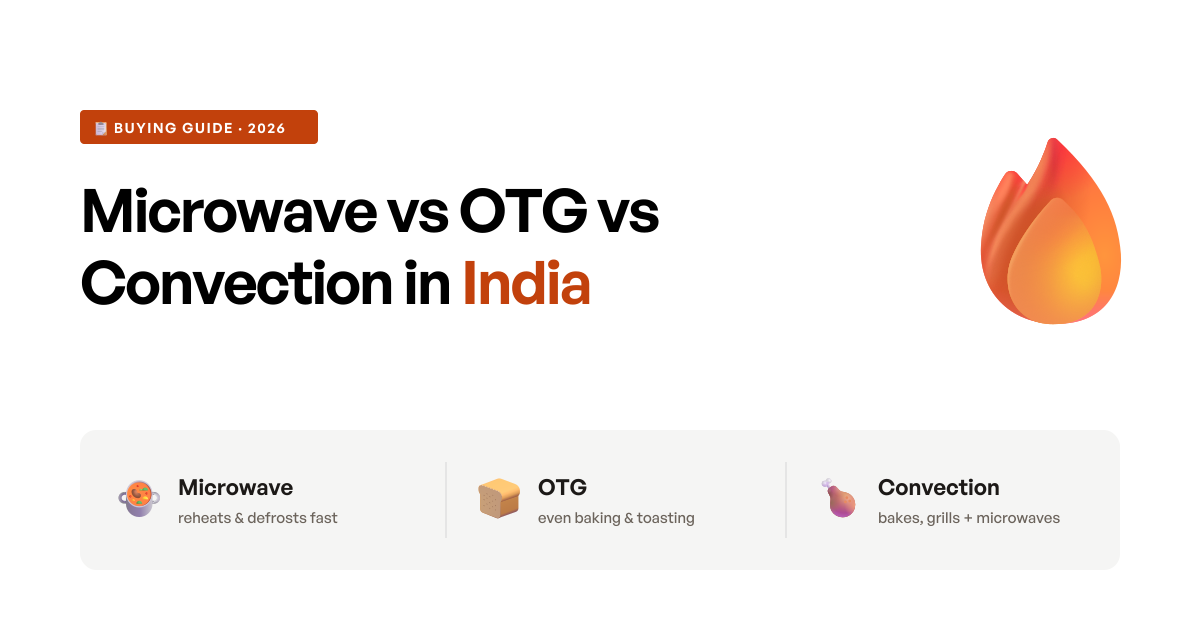
Three appliances, one confused aisle - and 'convection' isn't even a separate machine, it's a feature bolted onto a microwave or an OTG. This sorts out what each one actually does, which your kitchen needs, and the duller things that decide whether it survives past year two.
The quick answer
For most Indian kitchens, the one appliance to buy is a convection microwave - it reheats and defrosts like a normal microwave and bakes, grills and roasts like a small oven, so it does the work of two machines in one footprint. That single recommendation covers the large middle of buyers: a family that reheats every day and bakes a cake or roasts a chicken now and then.
The interesting cases are the edges. If you genuinely only ever reheat, defrost and warm food, a plain solo microwave does that for a third of the price, and you’re paying nothing for baking hardware you won’t touch. If you bake seriously and often - cakes most weekends, bread, multiple trays - a dedicated OTG bakes more evenly, comes in far larger sizes, and costs less than a convection microwave of the same capacity, though it can’t reheat. And “convection” itself trips people up, because it isn’t a third kind of machine at all - it’s a mode you add to a microwave (or an OTG), which is the first thing worth clearing up.
Everything below is how to work out which case you’re in. If you’ve already decided you want a microwave and just need the model, our best microwave oven in India review names the specific solo, grill and convection picks with current prices and the verified-owner verdicts behind them.
Microwave, OTG and convection: what each one actually is
Start by clearing up the naming, because the aisle is genuinely confusing on this point. There are really only two appliances here, plus a feature that gets sold as if it were a third.
A microwave oven cooks with microwaves - electromagnetic waves that make the water molecules in food vibrate and heat up from the inside. That’s why it reheats a plate of leftovers in ninety seconds and defrosts frozen chicken in minutes, and also why it can’t brown, crisp or bake on its own - microwaves don’t create the dry, hot surface that browning needs. Microwaves come in three grades:
- Solo - microwaves only. Reheats, defrosts and cooks. The cheapest type, and all that most people who “just want to heat things up” actually need.
- Grill - a solo plus a heating element, so it browns and crisps as well: tikka, kebabs, toast, a cheese melt.
- Convection - a solo plus a fan and a heating element that circulate hot air, so it bakes cakes and roasts like a small oven on top of microwaving. The do-everything type.
An OTG (oven toaster griller) has no microwaves at all. It’s a compact electric oven: heating coils at the top and bottom of the cavity get hot, and that radiant heat bakes, grills and toasts the food, exactly the way a full-size oven does. It’s what most home bakers in India use. The trade-off is the mirror image of the microwave’s - it bakes and grills well but can’t do the quick reheat-and-defrost job, and a basic OTG with no fan heats a little unevenly until you add a convection fan.
So “convection” is not a separate appliance - it’s the fan-plus-element feature that lets an oven bake with even, circulated heat. You’ll see “convection microwave” (a microwave that can also bake) and “convection OTG” (an OTG with a fan for more even baking). When someone asks “microwave vs OTG vs convection”, the honest translation is: a plain microwave for reheating, an OTG for baking, or a convection microwave that tries to do both. The rest of this guide is which of those three your kitchen actually wants.
The three questions that actually decide it
You can skip almost every spec on the box and answer three questions instead.
1. Do you need to reheat and defrost? This is the microwave’s unique job - warming leftovers, milk, dal and rice in seconds, thawing frozen food without cooking it. An OTG can’t do this properly; it heats the air, so reheating is slow and dries food out, and you can’t quickly warm liquids. If reheating is a daily need - and in most Indian homes it is - you need a microwave of some kind, not an OTG.
2. Do you bake, and how seriously? If you never bake, you don’t need convection or an OTG at all, and a solo microwave is the cheaper, simpler buy. If you bake occasionally - a birthday cake, the odd batch of cookies - a convection microwave handles it. If you bake often or in quantity, an OTG bakes more evenly, in bigger sizes, with finer low-temperature control, and is the baker’s choice.
3. What will survive your kitchen? This is the question buyers skip and regret. In India the thing that decides whether an oven is still working in year three isn’t the type - it’s the control panel (a touch membrane dies far sooner than mechanical buttons), the cavity material (painted steel rusts in a humid kitchen; stainless and ceramic don’t), and whether the brand will actually service a dead magnetron or panel in your city. We’ll come back to all three, because they matter more than the headline specs.
And the specs that mislead, the ones you can mostly ignore: capacity in litres beyond matching your largest dish, wattage (the gap between an 800W and a 900W microwave changes nothing on a weeknight), and the auto-cook menu count - nobody uses more than a handful of the “101 menus”; they punch in a time by hand.
Microwave vs OTG vs convection: the head-to-head
Here are the three options side by side on the things that actually differ. “Microwave” here means a plain solo or grill; “convection microwave” is the do-everything type; “OTG” is the coil oven.
| Solo / grill microwave | Convection microwave | OTG | |
|---|---|---|---|
| Reheat / defrost | Yes, fast (its core job) | Yes, fast | No - slow, dries food |
| Bake cakes / bread | No (grill browns only) | Yes, occasional baking | Yes - best and most even |
| Grill / roast | Grill yes; no roast | Yes | Yes (often with rotisserie) |
| How it heats | Microwaves (inside-out) | Microwaves + fan and element | Coils, top and bottom (radiant) |
| Preheating | None | None for microwaving | Needed for baking |
| Typical power | 800-1200 W | 800-1200 W (more on bake) | 1200-2000 W |
| Capacity range | ~20-32 L | ~20-32 L | ~10-60 L |
| Price for the size | Lowest | Highest | Lower than convection |
| Best at | Reheating | A bit of everything | Serious baking and grilling |
Read the table and the pattern is clear: the microwave owns reheating, the OTG owns baking, and the convection microwave is the compromise that does both adequately without being best at either. There’s no single winner - there’s the right one for what you cook.
Solo vs grill vs convection microwave
If you’ve decided on a microwave, the only choice that really matters is which of the three grades, and it’s decided entirely by whether you want to brown or bake.
| Solo | Grill | Convection | |
|---|---|---|---|
| Reheat / defrost / cook | Yes | Yes | Yes |
| Brown / grill (tikka, toast) | No | Yes | Yes |
| Bake / roast | No | No | Yes |
| Relative price | Lowest | Middle | Highest |
| Best for | Reheating only | Reheating + grilling | One box that also bakes |
Buy a solo if you only reheat, defrost and warm food - there’s nothing to go wrong with a fan or element you don’t have, and it’s the cheapest. Buy a grill if you also want to brown and crisp - tikka, kebabs, toast - without paying for full convection. Buy a convection if you want to bake and roast, because it’s the only grade that can. The honest rule of thumb: a convection microwave future-proofs you, but only if you’ll actually bake; if you know you’ll only reheat, the solo is the smarter, cheaper buy. The best microwave oven review has tested picks in each grade.
When an OTG is the smarter buy (and when it’s a mistake)
The convection microwave is the default, but there’s a real case for an OTG, and it’s worth making honestly rather than steering everyone to the pricier do-everything box.
Buy an OTG if baking is the point. An OTG bakes more evenly than a convection microwave, gives you direct temperature control across roughly 100 to 250 degrees Celsius, and comes in sizes a microwave never reaches - up to 60 litres, enough for multiple trays or a large cake. Its coils give the steady bottom-and-top heat that bread and bigger bakes want, and because it’s a simpler machine - coils, a thermostat, a timer, no magnetron or touch board - there’s less electronics to die. For a keen home baker, an OTG is the better and often cheaper tool, and many serious bakers keep one alongside a basic microwave for exactly this reason.
An OTG is a mistake if you bought it to reheat. This is the regret to avoid: an OTG can’t do the everyday microwave job. It heats the air, not the food, so warming a plate of leftovers is slow and dries them out, you can’t quickly heat milk or dal, and there’s no proper defrost. If your main need is reheating and you buy an OTG because it was cheaper or “also bakes”, you’ll be disappointed every evening and bake twice a year. For most kitchens reheating is the daily job - which is why the microwave, or the convection microwave, wins for the majority, and the OTG is the specialist’s pick.
Get the size right
Capacity is where money gets wasted in both directions - buying too small to save a little, or buying a cavernous oven that eats your counter and your budget. Match the litres to the largest dish you’ll regularly cook, not to a round number.
For a microwave:
| Household / use | Capacity |
|---|---|
| 1-2 people, mostly reheating | ~20 L |
| Family of 3-4, reheat + some cooking | 20-25 L |
| Family that bakes or roasts on convection | 28-30 L |
For an OTG, the range is much wider because it’s a baking tool first:
| Household / use | Capacity |
|---|---|
| Individual / occasional small bakes | 10-20 L |
| Family of 4, regular baking | 25-30 L |
| Frequent entertainers / joint family | 30-60 L |
A 20-litre OTG is fine for toast and a single cake tin but cramped for a full tray, so if you bake for a crowd, size up. With a convection microwave, remember the rated litres include the turntable space, and it’s the bigger 28-to-30-litre models that actually fit a cake tin or a roast - a 20-litre convection bakes, but only small. When you’re genuinely on the boundary, size up: an empty shelf costs nothing, an oven you can’t fit the dish into costs you every time.
The specs that decide how long it lasts
This is the section the brochures don’t write, and the one that separates an oven you still use in year four from one that throws an error and dies by month fourteen. It’s a higher-failure category than buyers expect, so weight these over the spec sheet.
The control panel is the part that most often dies. On modern microwaves and convection ovens, the single most common terminal failure isn’t the magnetron - it’s the touch panel, the flat membrane you press to set time and power. Heat, steam and kitchen humidity degrade it, and once it fails the buttons stop responding and the oven is effectively dead; an out-of-warranty replacement panel commonly runs ₹3,000 to ₹4,500, a big slice of a budget oven’s price. Ovens built on simple mechanical or tact buttons sidestep the failure almost entirely. This one fact should move your decision more than any number on the box - a durable-button grill that lasts beats a touch-panel convection that bricks.
Cavity material decides whether it rusts. The cavity is the box your food sits in, taking constant steam. A stainless-steel or ceramic-enamel cavity shrugs that off; painted steel can chip and rust, especially in a humid or coastal kitchen, with owners reporting the inside corroding within a couple of years. It’s an easy spec to overlook and a real longevity difference, so prefer stainless or ceramic enamel if your kitchen is at all damp. Note too that a brand’s headline “10-year warranty” usually covers only this cavity against rust, not the electronics that actually fail.
Inverter vs conventional, in plain English (microwaves only). A conventional microwave’s magnetron has one setting, full power, so to “do” 50 percent power it pulses fully on and off - which is why edges overcook while the centre stays cold and the turntable has to spin. An inverter microwave modulates a steady, lower stream of power instead, so it heats and defrosts more evenly and treats delicate food more gently. It’s a genuine improvement, popularised by Panasonic, and worth having if even reheating and gentle defrosting matter to you - though it’s a nice-to-have, not the thing that decides reliability.
The magnetron and the warranty that matters. The magnetron is the tube that generates the microwaves and the costliest core part to replace. A standard warranty is one year on the whole product; the cover worth looking for is a separate, longer magnetron (and cavity) warranty - three years is the strongest we’ve seen - because that’s the part a paid repair hits hardest after the first couple of years.
What you’ll actually spend
Specific current prices live in the reviews, which we refresh; these are the evergreen bands to work out which class you’re shopping in.
| Type | Street-price band | What it buys |
|---|---|---|
| Solo / compact grill microwave | ~₹6,000-8,500 | Reheating, defrosting, some grilling |
| Convection microwave (20-28 L) | ~₹10,000-14,000 | Reheat + bake and roast, one box |
| Large convection microwave (30 L, rotisserie) | ~₹16,000 and up | Do-everything, best service cover |
| OTG (small to large) | ~₹3,000-10,000+ | Baking and grilling, cheaper per litre, no reheat |
Two notes on price. First, an OTG is cheaper per litre than a convection microwave because it’s a simpler machine - so if baking is genuinely all you want, the OTG saves money and bakes better, and the convection microwave only justifies its premium if you also need it to reheat. Second, ignore the slashed “MRP”. A microwave with a ₹18,000 MRP selling at ₹11,000 didn’t save you ₹7,000 - the MRP was fiction. Judge the street price on its own.
Standards, star ratings and service in India
This is the part a generic global comparison can’t write, and it’s where the real decision sits.
Safety is mandatory; energy stars are not. Every microwave oven legally sold in India must carry BIS registration under IS 302 (Part 2/Sec 25) - the safety standard covering electrical, fire and radiation-leakage risk, compulsory since 2013. That’s a genuine floor: buy from a normal retail listing and the oven meets it. What is not guaranteed is an energy rating - microwave ovens fall under BEE’s voluntary star-labelling scheme, so manufacturers choose whether to rate them, and many carry no BEE star at all (OTGs aren’t in the scheme either). Refrigerators and air conditioners, by contrast, must be rated. The practical upshot: unlike a fridge, you usually can’t compare two microwaves on stars - so judge them on type, controls, cavity and service instead, not on a label that may not exist.
Service is the number no spec prints, and the one that should move your decision as much as the type does. Microwaves fail more than buyers expect - touch panels die, magnetrons go, handles snap - so the brands worth paying for are the ones that actually fix it. In the verified-owner reviews behind our microwave oven review , IFB’s in-home demo and installation stands out, backed by a three-year magnetron-and-cavity warranty; Panasonic and Samsung have real networks but draw mixed-to-poor responsiveness, and LG fared worst on parts delays and post-warranty support. Whatever you’re drawn to, do the one check that matters: confirm the brand has an authorised service centre in your city and that spares for your model are available. A microwave you can’t get a panel or magnetron replaced for is the wrong microwave, however good the specs.
Running cost and maintenance
A microwave is cheap to run because it heats the food directly in short bursts - typically 800 to 1200 watts for a minute or two at a time, not an hour - so for reheating and quick cooking it’s the most efficient of the three by a clear margin. An OTG draws more (1200 to 2000 watts) and has to preheat and hold the whole cavity hot for the length of a bake, so per session it uses more; a convection microwave on bake sits in between. None of it is a large monthly cost unless you bake daily - the running-cost difference between these appliances is real but small next to the buy price, so don’t let it drive the decision.
Maintenance is undramatic. Wipe spills promptly with a soft damp cloth so they don’t bake on, and so a painted cavity doesn’t start to rust; never run a microwave empty or put metal or foil inside it; and use only microwave-safe glass, ceramic or marked plastic. On a grill or convection oven the metal rack and the cavity get genuinely hot, so use mitts. That’s the whole list - neglecting the cavity and using the wrong containers is what turns a healthy oven into a repair.
Common mistakes
- Buying a convection microwave for baking you’ll never do. If you don’t actually bake, you’re paying for a fan and element that gather dust; a solo microwave reheats for far less.
- Buying an OTG to reheat. The same mistake in reverse - an OTG can’t do the daily microwave job, and you’ll feel it every evening. Reheating means a microwave.
- Reading litres, watts and menu counts. None of them predict a good oven. Match capacity to your largest dish, ignore the 800-versus-900-watt gap, and know you’ll use five presets at most.
- Trusting a touch panel for the long haul. On an oven you mean to keep for years, the membrane is the part that fails; favour mechanical or tact buttons, or price an extended warranty.
- Choosing on sticker price over serviceability. The cheapest oven from an absent service network costs more over its life than a slightly dearer one you can actually get fixed.
- Believing the MRP discount. The “saving” is usually fiction; judge the street price, and buy in a sale if you can.
Which one for your situation
- You mostly reheat dal, rice, leftovers and milk - a solo microwave is all you need, and the cheapest honest buy. Start with the solo picks in our best microwave oven review .
- You reheat daily and bake or roast now and then - a convection microwave is the one-box answer and the mainstream recommendation. The convection picks in the microwave oven review cover both compact and large options.
- You also want to grill tikka and toast, but won’t bake - a grill microwave is the middle ground: browning without paying for full convection.
- You bake seriously and often - buy a dedicated OTG (25 to 30 litres for a family, more if you entertain), and keep a basic microwave alongside if you also reheat. An OTG bakes better and cheaper than any convection microwave; a dedicated OTG review is on the way, so for now match the size-and-controls logic above.
- You mainly want to air-fry and crisp small portions - that’s a different appliance again, and our best air fryer in India review covers it; an air fryer often makes more sense than an OTG for a small household that crisps more than it bakes.
- Your kitchen is humid or coastal, or in a tier-2 or tier-3 town - weight a stainless or ceramic cavity over painted steel, mechanical buttons over a touch panel, and the brand with real local service. Those three decide whether the oven lasts, more than the type does.
Frequently asked questions
What is the difference between a microwave, an OTG and a convection oven?
A microwave heats food from the inside out with microwaves - it reheats and defrosts fast but can't brown or bake on its own. An OTG (oven toaster griller) heats with metal coils at the top and bottom, like a small conventional oven, so it bakes, grills and toasts but can't do the quick microwave reheat. A convection oven isn't a separate appliance - it's a microwave (or an OTG) with a fan and a heating element added, so it both microwaves and bakes or roasts. In short: microwave is for reheating, OTG is for baking, and a convection microwave does both in one box.
Is a microwave or an OTG better for baking cakes?
For serious or frequent baking, an OTG bakes more evenly and gives finer low-temperature control, because its coils heat the whole cavity and you set the temperature directly - it's what most Indian home bakers prefer for cakes, cookies and bread. A convection microwave bakes well enough for the occasional cake and has the advantage of also reheating, but its convection minimum temperature is often higher, so delicate low-temperature bakes can scorch at the edges. A plain solo microwave can't really bake at all beyond a spongy mug cake. Bake often, buy an OTG; bake now and then and want one box, buy a convection microwave.
Can a convection microwave replace an OTG?
For most households, yes. A convection microwave bakes, grills and roasts like an OTG and also microwaves, so it does the job of two appliances in one footprint - which is why it's the sensible single buy for a kitchen that bakes occasionally. Where it can't fully replace an OTG is volume and even-ness: OTGs come in much larger sizes, up to 60 litres, bake multiple trays more evenly, and give better bottom heat for bread. If baking is a real hobby, keep a dedicated OTG; if it's the odd weekend cake, the convection microwave wins on flexibility.
Do I really need both a microwave and an OTG?
Only if you bake seriously and also reheat daily. The two do genuinely different jobs - a microwave reheats and defrosts in seconds, an OTG bakes and grills properly - so a keen baker who also wants fast reheating is the one household that benefits from owning both. Everyone else is better served by a single convection microwave, which covers both jobs adequately. Buying both as insurance usually ends with an OTG that gathers dust, or a microwave used only to warm milk.
Which uses more electricity, a microwave or an OTG?
For the same task, a microwave almost always uses less, because it heats the food directly in short bursts (typically 800 to 1200 watts for a minute or two), while an OTG draws more (1200 to 2000 watts) and has to preheat and hold the whole cavity hot for the length of a bake. So for reheating and quick cooking the microwave is clearly cheaper to run; for baking the two are closer, but the OTG's preheating and longer cook times mean it rarely comes out ahead. Neither is a large monthly cost unless you bake daily.
Can you reheat food in an OTG?
You can warm food in an OTG, but slowly and not the way a microwave does. An OTG heats the air around the food with coils, so a plate of leftovers takes several minutes and dries out more than it would in a microwave, and you can't quickly warm liquids like milk or dal or properly defrost. An OTG is built for baking, grilling and toasting, not the daily reheat-and-defrost job - if reheating is your main need, buy a microwave, not an OTG.
What can a convection microwave do that a solo microwave can't?
A solo microwave only reheats, defrosts and cooks with microwaves - it can't brown, crisp or bake. A convection microwave adds a fan and a heating element, so on top of microwaving it bakes cakes, roasts chicken and grills, working like a small oven. That makes it the do-everything type and the more expensive one. If you only ever reheat, the convection hardware is money and complexity you won't use; if you want one appliance that also bakes, it's worth the step up.
Is an OTG good for Indian cooking?
For the baking and grilling side - cakes, cookies, bread, tikka, kebabs, grilled paneer, a roast - an OTG is excellent, and it's what many Indian home bakers swear by for its even heat and direct temperature control. What it doesn't do is the everyday Indian-kitchen job of reheating dal, rice and rotis or warming milk, which is the microwave's territory. So an OTG suits a household that bakes and grills regularly; for a home whose main need is reheating leftovers, a microwave or convection microwave fits the routine better.
Do microwave ovens have a BEE star rating in India?
Sometimes, but you can't rely on it. Microwave ovens fall under BEE's voluntary star-labelling scheme, which means manufacturers choose whether to get their models rated - unlike refrigerators and air conditioners, where the star label is mandatory. Many microwaves carry no BEE star at all, and OTGs aren't part of the scheme either. So unlike with a fridge, you can't compare two microwaves head to head on stars; judge them on type, controls, cavity and service instead. What is mandatory is BIS safety registration under IS 302-2-25, which every microwave legally sold in India must carry.
What size microwave or OTG do I need for a family of four?
For a microwave, a family of four is comfortable with 20 to 25 litres for reheating and solo cooking, stepping up to 28 to 30 litres if you'll use the convection mode to bake or roast for everyone. For an OTG, 25 to 30 litres fits a family of four - big enough for a standard cake tin or a medium chicken - while 30 to 60 litres suits frequent entertainers or joint families. Match the size to the largest dish you'll regularly cook, not to a round number; a bigger oven just costs more and eats counter space you may not have.
Which is cheaper to buy, an OTG or a convection microwave?
An OTG is usually cheaper for a given size, because it's a simpler machine - coils, a thermostat and a timer, with no magnetron or microwave electronics. Small OTGs start lower than any microwave, and even a large 30-litre-plus OTG typically costs less than a convection microwave of similar capacity, which charges a premium for packing two technologies into one box. The honest trade-off: the OTG is cheaper and bakes better, but it can't reheat - so a convection microwave can still be the better value if it saves you buying a separate microwave.
Why do microwave touch panels stop working?
The touch panel - the flat membrane you press to set time and power - is the single most common terminal failure on modern microwave and convection ovens, usually at one to two years. Heat, kitchen steam and humidity degrade the thin membrane and the board behind it, and once it throws an error (Samsung's is the SE code) the buttons stop responding and the oven is effectively dead. An out-of-warranty replacement panel often costs ₹3,000 to ₹4,500, a big chunk of a budget oven's price. Ovens with simple mechanical or tact buttons sidestep the failure entirely, which is why durable controls matter more than the menu count.